Skip to content

Posts by FeyGirl

Great [Blue] Daddy!

From the Cornell Lab of Ornithology, check out this amazing time-lapse video of a male Great Blue Heron, as he diligently protects 5 eggs during an April 27 snowstorm. All 5 hatched — despite the snow, and despite constant owl attacks. What a good daddy!!


The Cornell Lab features some fascinating live feeds of various birds, and now the Great Blues are nesting…. But numerous species are featured on their live cams.

Visit the Cornell Lab of Ornithology for more information.

Pretty in Purple

Purple Gallinules are one of the shyer creatures of our wetlands, and to spy one is a fun and colorful event. Even if you’re a sly watcher and/or photographer, they’ll quickly flit into the dense marsh vegetation when they sense your presence…. It’s ironic, being as shy as they are, with such bold coloring. But it’s always a joy to spy these purple, blue, and green gems — especially so for me, as they’re all my favorite colors, wrapped up into one bright little bird.

These lovely creatures live in the freshwater marshes of the southeastern United States, as well as in Central America and the Caribbean — although they have turned up in the northern states and southern Canada, and even in parts of Europe and South Africa. There’s no mistaking this medium-sized rail, with its purple-blue plumage, green back, pale blue forehead, white undertail (of which I’ve caught more than one glimpse), bright red and yellow bill, and long yellow feet. The juveniles sport blander, brown colorations. The  gallinules’ huge legs make them awkward fliers, so short bursts of activity are their mode of transportation — or swimming like a duck if they’re not navigating the marsh with those dangling legs. They nest in floating constructs in the mashes (although I haven’t spotted many — they’re quite well hidden), laying 5-10 eggs.

The Purple Gallinule is omnivorous, eating the seeds, leaves, fruits, and grains of both aquatic and terrestrial plants; they also enjoy insects, frogs, snails, spiders, earthworms, fish, and even the eggs and young of other birds. When I see them in our wetlands, they’re often alone, nestled in the vegetation and cackling away — or being chased by other birds, most often by their sister species the Common Moorhen.

Purple Gallinule

Purple Gallinule — Nice Legs

Purple Gallinule

Purple Gallinule — White Undertail on Display

Purple Gallinule about to be chased into dense marsh vegetation by a defensive moorhen parent

Purple Gallinule successfully chased into dense marsh vegetation by a defensive moorhen parent

Thanks, Mr. Sendak, and Farewell…

Thank you Mr. Sendak, for teaching me all about those wild places. ♥

Maurice Sendak, Children’s Author Who Upended Tradition, Dies at 83

Maurice Sendak, widely considered the most important children’s book artist of the 20th century, who wrenched the picture book out of the safe, sanitized world of the nursery and plunged it into the dark, terrifying and hauntingly beautiful recesses of the human psyche, died on Tuesday in Danbury, Conn. He was 83 and lived in Ridgefield, Conn. The cause was complications from a recent stroke, said Michael di Capua, his longtime editor…. (Read more at The New York Times link above)

Maurice Sendak, “Where the Wild Things Are,” 1963

Maurice Sendak, “Where the Wild Things Are,” 1963

Time for Empty Nest Syndrome… Or Not?

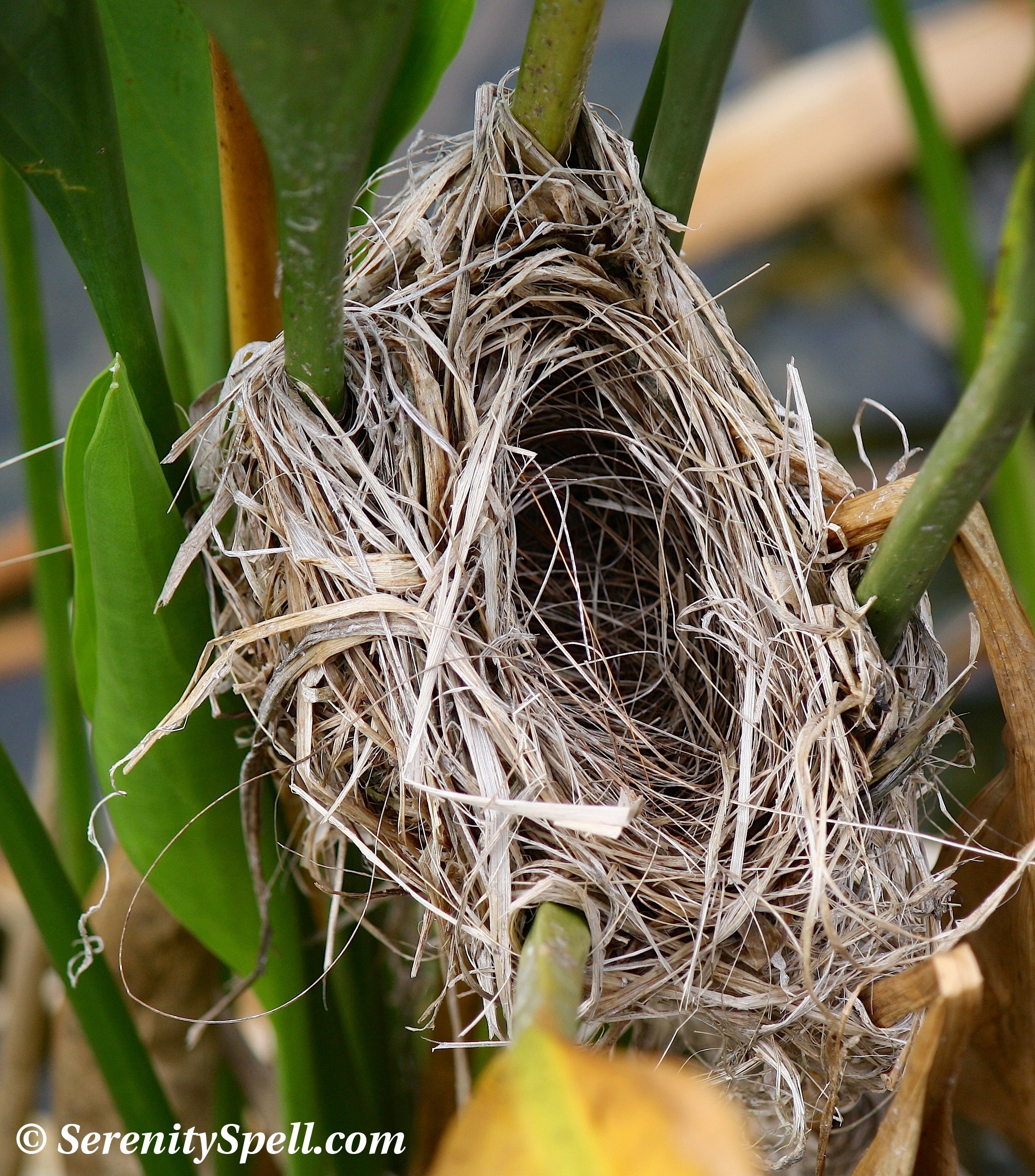
I’ve written a post or two on the Red-winged Blackbirds — common songbirds found in most of North and much of Central America, and familiar sights in our protected wetlands and Everglades. The males, glossy black with scarlet-and-yellow shoulder patches, puff up or hide depending on their level of confidence. In our marshes, they’re quite brave (or protective, in defense-mode), doing their hardest to get noticed, and belting out their conk-la-ree songs. The female, subdued brown with streaks of lighter colorations, is much shyer than her male counterpart. Her brownish coloring serves to camouflage her and the nest, while she’s incubating. Staying low in the vegetation, she searches for food (eating primarily seeds and insects) and weaves her amazing nest. Constructed entirely over the course of 3-6 days — with no help from the males — the nests are woven in cattails, rushes, grasses, or in alder or willow bushes. Located near the water’s surface, the nest is a basket constructed of grasses, sedge, and mosses, lined with mud and bound to surrounding grasses or branches. I’ve watched for nearly an hour in awe, as a female patiently gathered her grasses from the surrounding wetlands — and even longer as another intricately wove her basket-nest. It’s beautifully mesmerizing (and believe me, I’m no birdwatching crackerjack). Red-winged Blackbirds nest in loose colonies, and the males serve as sentinels to guard the nests, using various calls to denote the type and severity of danger against such predators as snakes, raccoons, iguanas, and other birds.

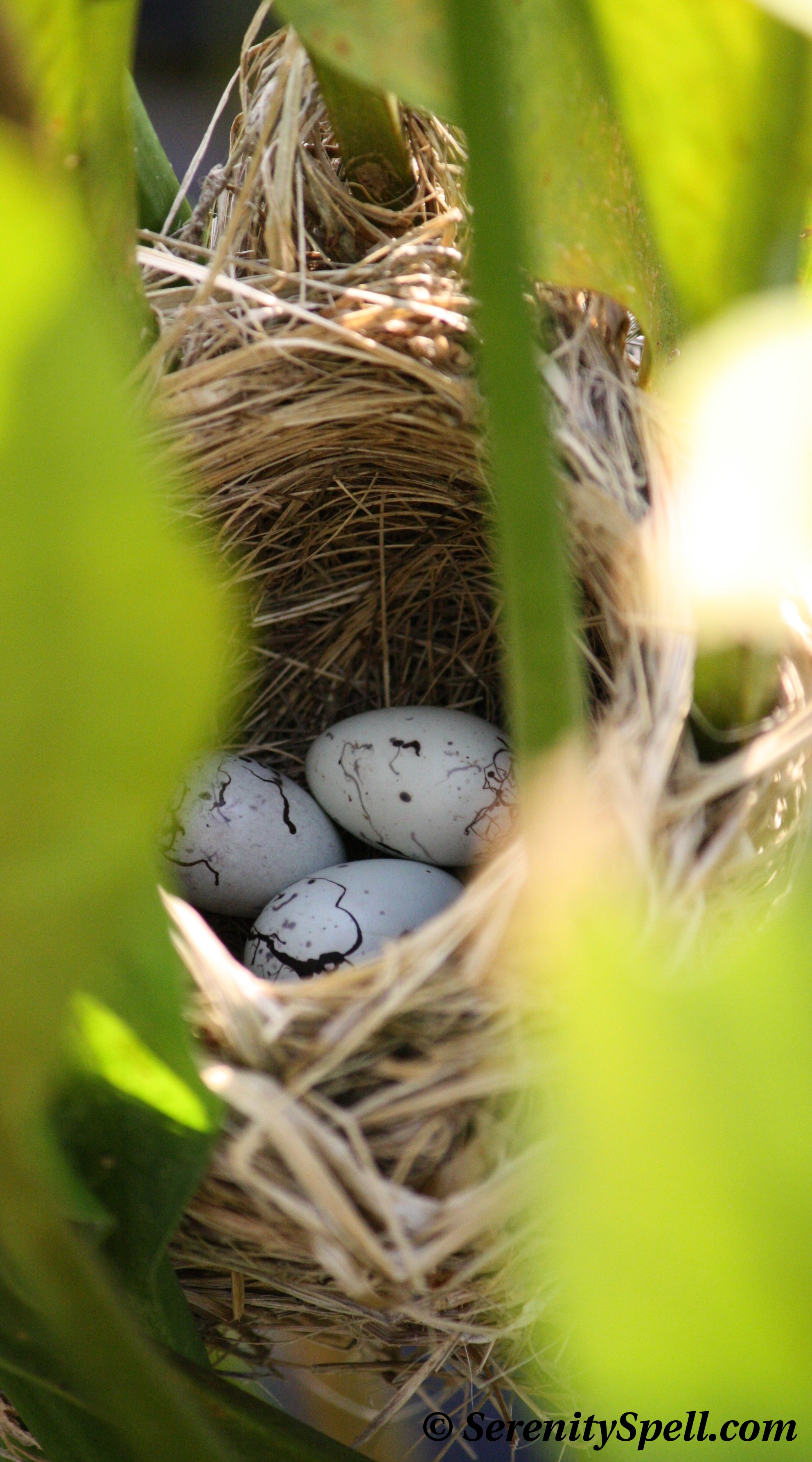
In my recent wanderings, I first became captivated by the spectacular artwork of the Blackbirds’ bluish eggs, marked with brown and/or black Pollock splatters. Incubated by the female alone, they hatched within 11-12 days. Being a large colony, there was no dearth of nests, but it wasn’t always easy to spy the eggs in the marsh vegetation:

Red-winged Blackbird Nest with Eggs

Then I fell in love with the hatchlings: born blind and naked, they were ready to leave the nest 11-14 days after hatching. Chirping away, they were ever-protected by their parents. But time flies quickly….

Red-winged Blackbird Nest with Hatchlings

Red-winged Blackbird Nest with Hatchlings

During recent walks, I began noticing more empty nests, over which I couldn’t help feeling irrationally sad…. Other than empty nests, I spied a momma Blackbird teaching her young ones early flight — or early adventures out of their nest. Was nesting season finished? Were there to be no more Red-winged Blackbird babies?

Empty Red-winged Blackbird Nest

Empty Red-winged Blackbird Nest

Empty Red-winged Blackbird Nest

Empty Red-winged Blackbird Nest

But over yonder! What was that commotion…. Lo and behold, a new nest! The male perched sentinel nearby, always the protector, while the female made her way to the nest, to incubate her new eggs. And the cycle continues, hoorah!

Female Red-winged Blackbird on Her Way to the Nest
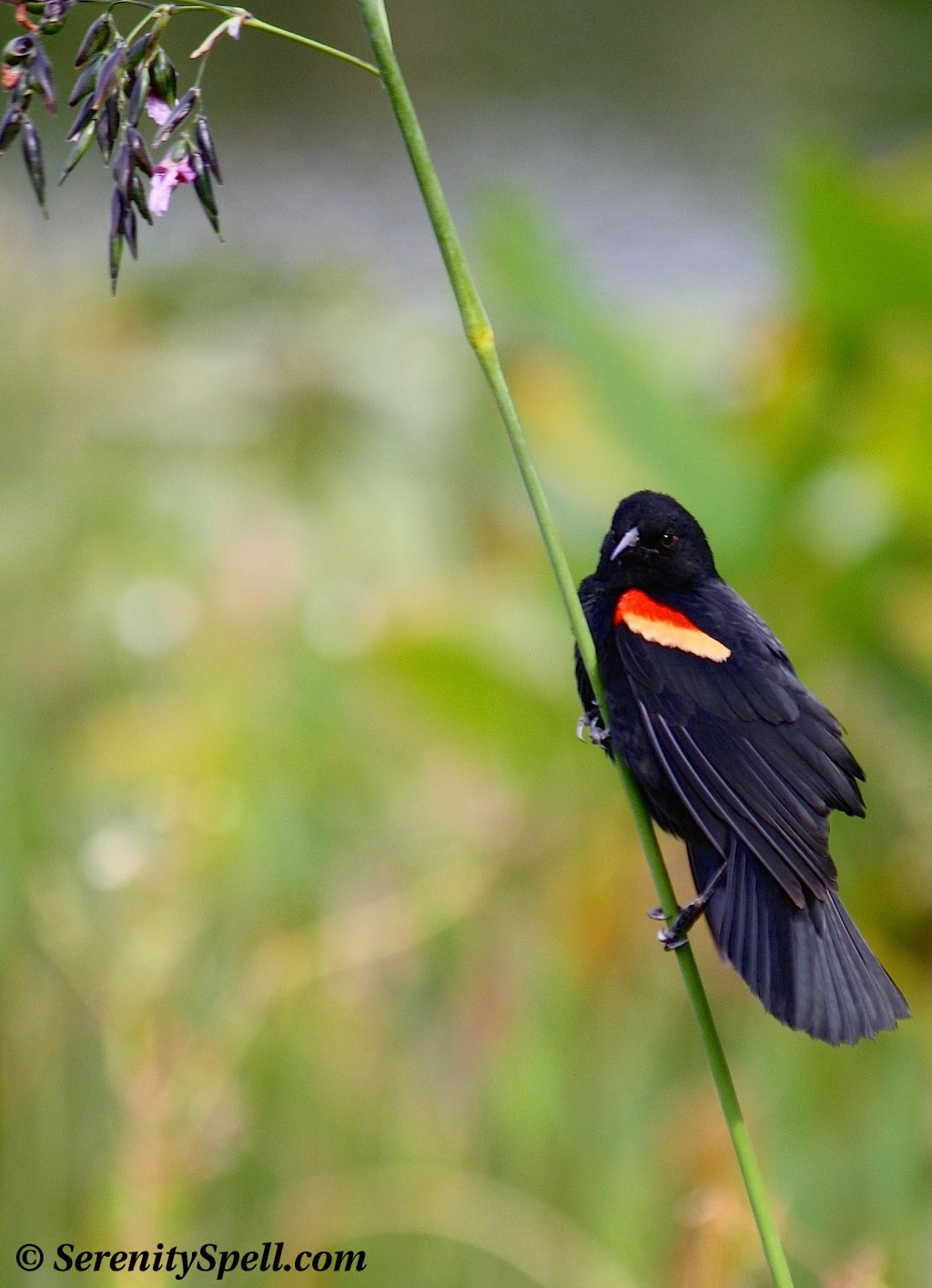
Red-winged Blackbird Sentinel

A new nest, with eggs!!

Red-winged Blackbird Nest with a New Momma

A Wonderful Project

I’ve fallen a bit behind… Fellow bloggers Fay Moore of her inspiring Fay Moore: I Want to Be a Writer and Stacy Lyn of her engaging Stacy Allbritton: Web-Footed Louisiana Scribbler, um, Scrivener have nominated me for the Versatile Blogger Award. And Terri of the beautiful Daily Sweet Peas has kindly passed along the Readership Appreciation Award.

I’ve been witness to this project circulating WordPress (being relatively new to the blogging arena), and it’s such a wonderful tool to connect with other bloggers and their work. I honestly had no idea such warm, kind kindred spirits existed in this community, and for that I’m pleasantly surprised and ever thankful. Profuse thanks for your nominations and votes of confidence, Fay, Stacy, and Terri!

 7 (Hopefully Interesting) and Totally Truthful Things About Myself:

  • I was raised on a 3-mile-long island, the rim of a sunken volcano in the middle of the South Pacific — an atoll in Micronesia — 6 hours by plane from Hawaii, 6 hours by plane from Australia. Think Amelia Earhart’s lost flight.
  • Having moved stateside at college-age, and lacking the impact of mass media at those impressionable ages, I still find myself catching up on key pieces of Americana.
  • I’ve been a vegetarian since birth… Raised by carnivores with favorite meals including steak tartare and sushi caught from the surrounding ocean. Blech.
  • I’ve never been married; while this fails to shock me or the strong females in my family, it remains an awe-inspiring topic of discussion.
  • Having always been surrounded by a menagerie of rescued critters — cats and dogs and ferrets and horses, oh my — they remain an integral part of my life.
  • My heroine: Katherine Hepburn.
  • I dance and sing horribly off-key on a regular basis — any event can prompt this behavior, including the making of ice, cooking noodles, rain, getting dressed…. The list is endless.

Every blog I’ve encountered has been inspiring beyond compare — and I’m still learning with each passing day. In the spirit of connecting to others, here’s an abridged list of some lovely and skilled nature-centric sites that I’d like to share: