Skip to content

Posts from the ‘Florida Birds’ Category

Flying Jewels

I captured this brave beauty at Butterfly World’s Jewels of the Sky Aviary, the largest free-flight hummingbird aviary in the United States. It’s a most amazing, beautiful, and fairy-like place — a huge and lush flower-filled habitat of Hummingbirds, Honeycreepers, and Euphonias.

Fun and Fascinating Facts About Hummingbirds:

    • Hummingbirds are the second largest family of birds, with more than 325 species
    • Early Spanish explorers called hummingbirds “Flying Jewels”
    • Hummingbirds are found only in North and South America
    • It’s the smallest bird — and the smallest of all animals — with a backbone
    • Despite their diminutive size, hummingbirds are aggressive and territorial, regularly attacking jays, crows and hawks
    • Hummingbirds have the largest brain of all birds — 4.2% of its total body weight
    • Many hummingbirds die during the first year but those that do survive have an average lifespan of 3-4 years. The longest-living hummingbird was a female Broad-tailed Hummingbird that was tagged and recaptured 12 years later
    • Hummingbirds have very weak feet — they cannot walk or hop, using them mainly for perching
    • Hummingbirds have great eyesight — able to see ultraviolet light, even — but have no sense of smell
    • The structure of hummingbirds’ lovely iridescent feathers amplifies certain wavelengths of light, reflecting them directly in front of the bird
    • Most of a hummingbird’s weight is in its pectoral muscles — 25-30% reside in their muscles responsible for flight
    • The average flight speed of a hummingbird is 20-30 miles per hour, though the birds can reach up to 60 mph in a courtship dive
    • They can beat their wings between 50-200 flaps per second, depending on flight patterns and wind conditions
    • The hummingbird can rotate its wings in a circle, making it the only bird that can fly forwards, backwards, up, down, sideways, and hover mid-air
    • Their heart beats at up to 1,260 beats per minute
    • A resting hummingbird takes an average of 250 breaths per minute
    • Hummingbirds must consume approximately half of their weight in sugar daily, feeding 5-8 times per hour. Much of the sugar they consume comes from flower nectar and tree sap, but they also eat insects and pollen to get their protein
    • A hummingbird uses its long, grooved tongue to lap up nectar from flowers and feeders
    •  To conserve energy — while sleeping or during food scarcity — hummingbirds can go into a hibernation-like state (torpor), where their metabolic rate is slowed to 1/15th of normal sleep. If they’re already weakened, they may not wake from this torpor
    • During their spring and fall migrations, the ruby-throated hummingbird makes a non-stop 500-mile-flight across the Gulf of Mexico
    • The longest migration of any hummingbird species is that of the rufous hummingbird — they travel more than 3,000 miles from their nesting grounds in Alaska and Canada to winter habitats in Mexico
    • Historically hummingbirds were killed for their feathers…. But today, habitat loss and destruction are the hummingbird’s main threats; changing temperatures are also affecting hummingbird migratory patterns, making it harder for them to find food
    • An increase in backyard gardens hummingbird feeders allows these birds to refuel during their long migratory journeys — YAY!

Sparkling violet ear hummingbird: I am so pretty, I am so pretty…

Sparkling violet ear hummingbird: Just adore me.
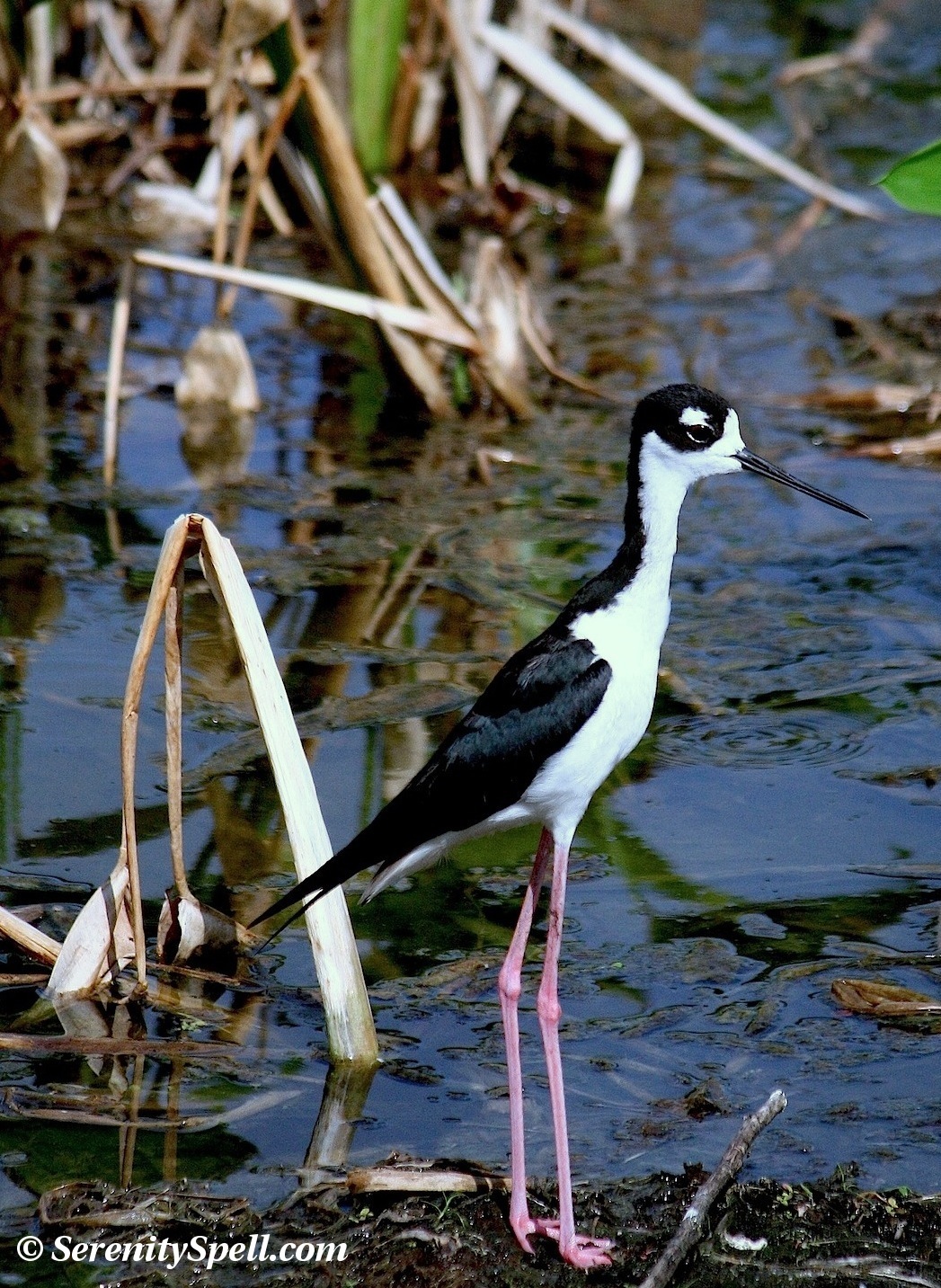
Tuxedoed Stilts

Black-necked Stilts (Himantopus mexicanus) are abundant residents of coastline, estuarine, and wetland habitats. They’re found across the country, from California to Florida, and through to Peru, northern Brazil, and the Galapagos islands. The Northern populations migrate south in the winter months.

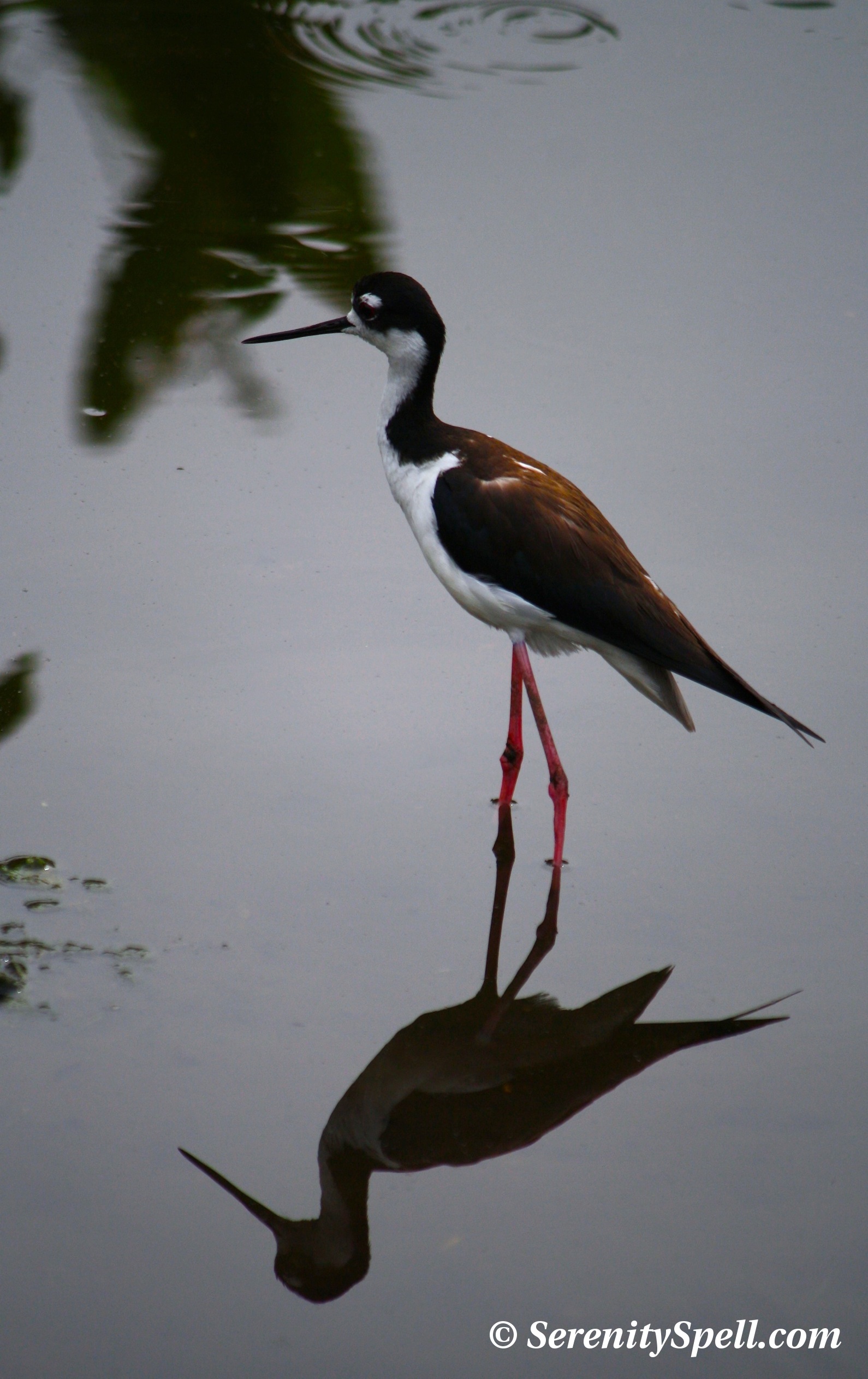
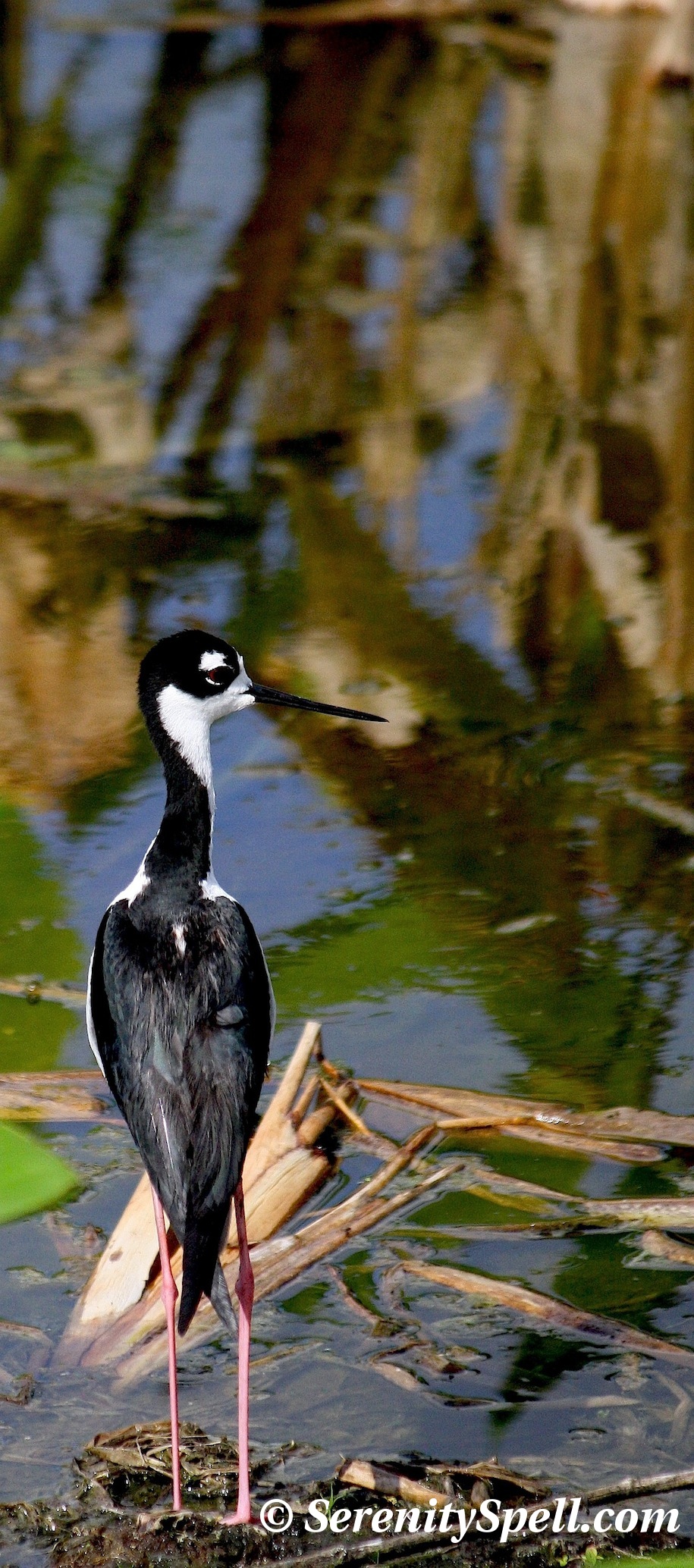
Adult Black-necked Stilts have long pink legs, a thin black bill, and are white with a black cap, neck, and back. They forage in the shallow waters of our wetlands, wading and probing for aquatic invertebrates and small fish. It’s a common sight to see them resting on the small “islands” of our wetlands, surrounded by water. The nests are constructed by both the male and the female, at ground-level and often close to the water’s edge, in semi-colonial formations (loose clusters), with peak nesting activity in June.

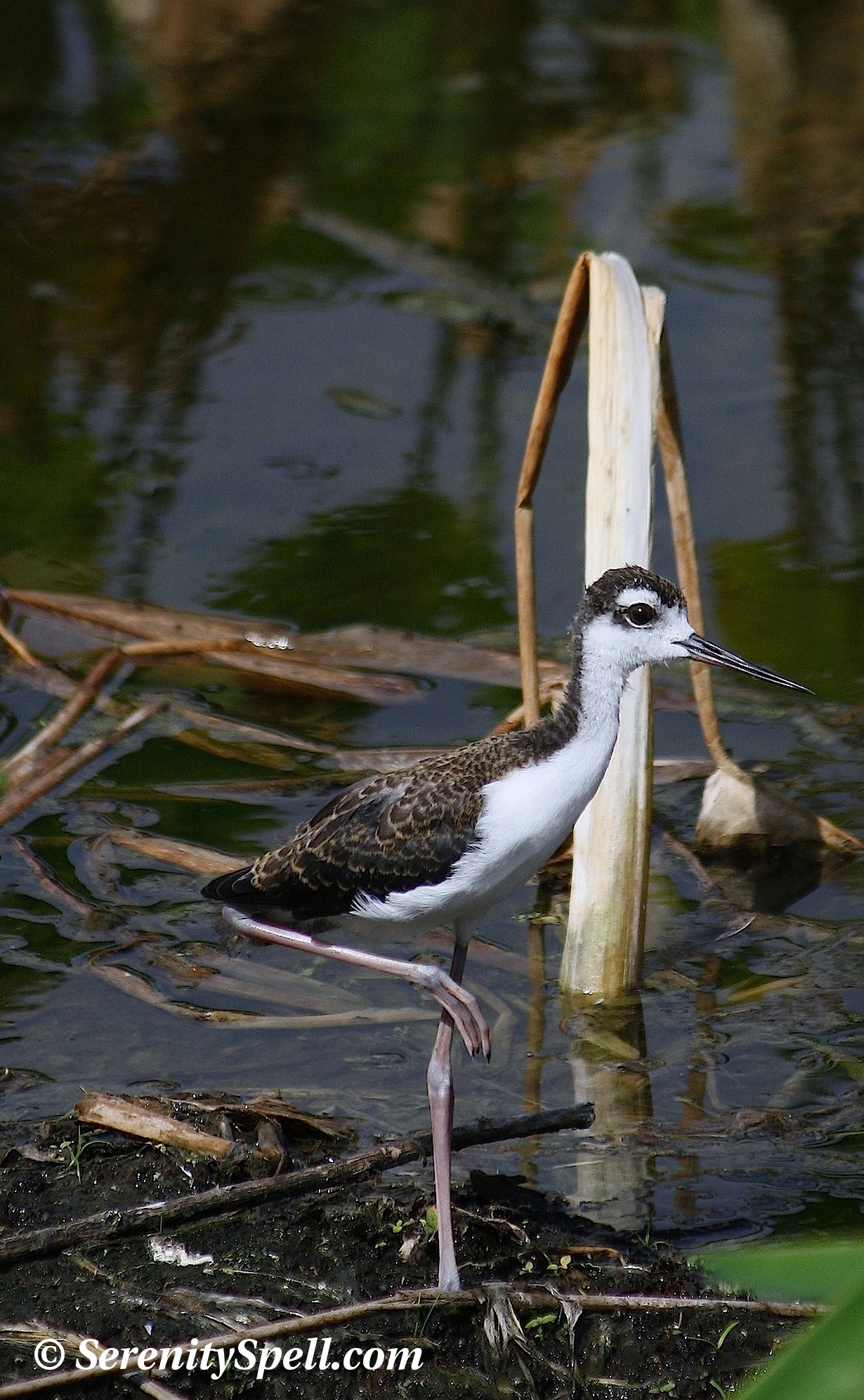
Here, I came upon a young stilt carefully guarded by its parent. I didn’t stay long, because my presence — despite my great distance on *dry land* — was disturbing the adult. I love seeing these guys in our wetlands: always in pairs, tuxedoed, debonair and elegant, but oh-so-shy.

Fun fact: Proportionate to their bodies, silts have the second-longest legs of any bird — exceeded only by flamingos.

Black-necked Stilt (Adult) guarding its young

Black-necked Stilt (Adult) guarding its young

Black-necked Stilt (Juvenile)

Black-necked Stilt at dusk in the wetlands

Black-necked Stilt foraging for grub in the wetlands

A Tiny and Striking Owl Finch

The love for all living creatures is the most noble attribute of man. ―Charles Darwin

The Owl Finch — Bicheno Finch, or Double-barred Finch — is native to Australia, and can be found in open savannah-like habitats. The “owl” part of this tiny and striking finch’s name is due to the dark ring of feathers around an otherwise white face. The rest of these finches sport black and brown on their upper bodies and throats, with white underneath. A black band divides the breast from the throat, with another black line dividing the chest from the belly area. Their wings are mostly black, layered with speckles of small white uniform dots.

Owl Finches are known to be friendly, and interact well with mixed species — and sure enough, these handsome little finches were twittering about the lush and fairy-like Butterfly World’s Jewels of the Sky Aviary, the largest free-flight hummingbird aviary in the United States — even cohabitating with the butterflies.

Owl Finch

Owl Finch Displays Its Lovely Wing Patterns

Owl Finch and Its Striking Facial Markings

Yellow on Red: Wild Canaries & a Powderfuff

Nature does not hurry
Yet everything is accomplished. —Lao Tzu

The Wild canary (Serinus Canaria) — Canary, Common Canary, or Atlantic Canary — is native to the Canary Islands, the Azores, and Madeira. These wild birds are mostly yellow-green, with brownish streaking on the back — similar to a sparrow in size and markings. It belongs to the finch family.

The bird is named after the Canary Islands, derived from the Latin Canariae Insulae, meaning “Islands of Dogs.” They were so named by the Romans, in honor of the islands’ native inhabitants breeding large dogs. So the word “Canary,” derived from the Latin Canis, means “dog.” The Spanish conquered the islands in the late 1400s, and returned to Europe with the yellow songbirds. From there, Italy, Germany, France, Belgium, and later the U.S. bred their own versions of these colorful little birds, primarily for their sweet song. Germany became the center for breeding canaries, and for training them to sing. They were so widely bred, that by the beginning of the 18th century, 29 distinct varieties were already in existence. Today, the species is common in captivity, with myriad color variations — and breeders striving for more color, song, and physical diversity. But taking a peek at the original Wild canary, it’s difficult to find similarities to the bright yellow counterparts you may encounter today. Personally, I find them that much lovelier.

During mining’s heyday, canaries were taken deep into coal mines to detect gases; being sensitive, they would soon die if gases were present. On that note, I give you The Police’s Canary in a Coal-Mine, a great ditty that’s been in my head for days, understandably….

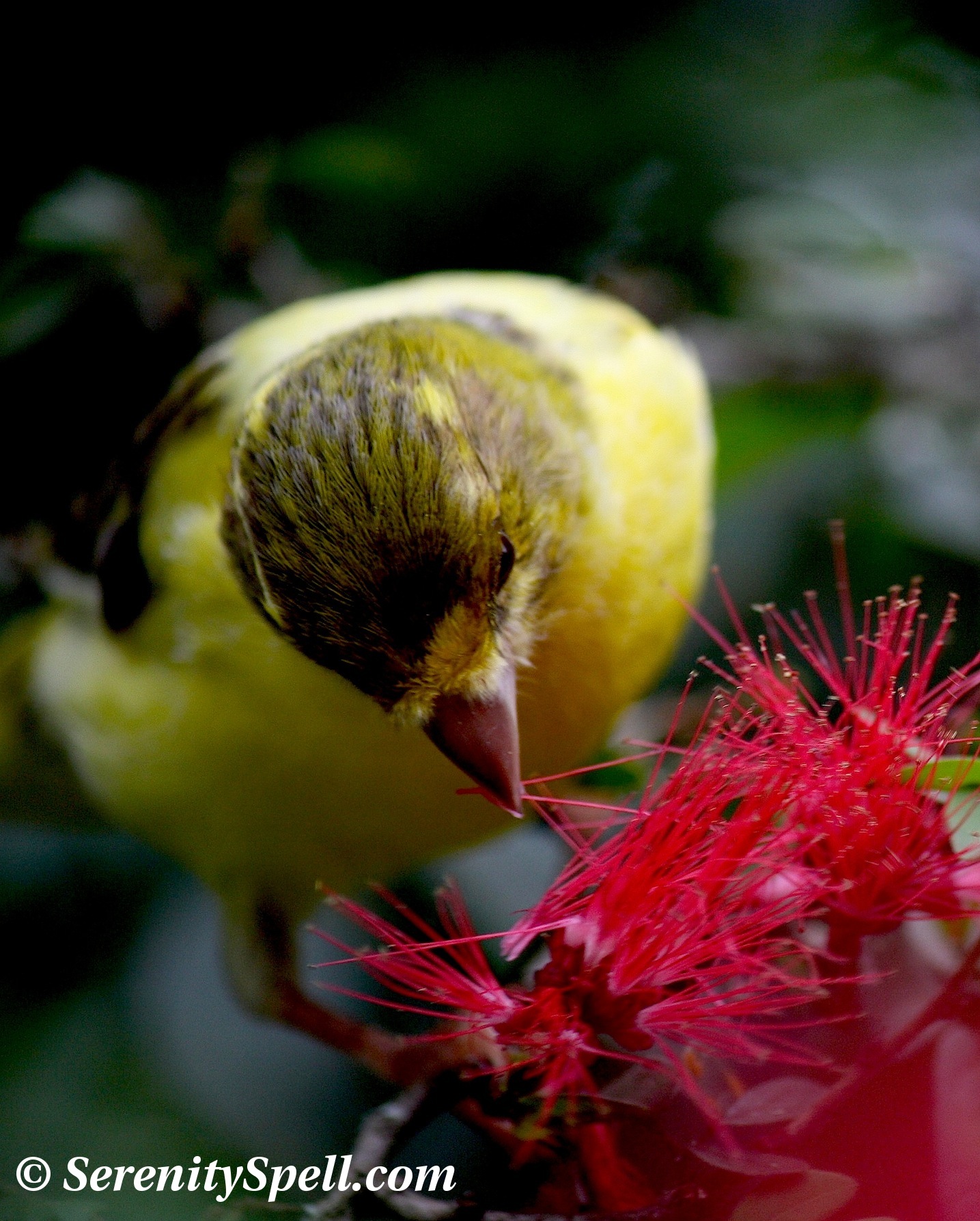
This golden beauty was twittering about the lush and fairy-like Butterfly World’s Jewels of the Sky Aviary, the largest free-flight hummingbird aviary in the United States. He finally settling on a Red Powderpuff plant (Calliandra haematocephala). Red Powderpuffs are subtropical shrubs/trees that are easy to grow (and not just in Florida, but they do grow LARGE here), and even better… They’re attractive to bees and butterflies — and obviously birds!

May your weekend be as golden and bright as this lovely little songbird!

Wild Canary Enjoying a Red Powderpuff Plant

Wild Canary Enjoying a Red Powderpuff Plant

Wild Canary Enjoying a Red Powderpuff Plant

Wild Canary Enjoying a Red Powderpuff Plant

Wild Canary Enjoying a Red Powderpuff Plant

Wild Canary Enjoying a Red Powderpuff Plant

A Young Great Blue’s Meal

I had been watching one of the Great Blue Herons at our local wetland preserves a few weeks ago; she only had one baby, which is a bit unusual for the species. I watched as she built her nest high in the cypress trees, then dutifully guarded it, alone…. There was no male in sight, which is likewise unusual. Usually both the male and female remain at the nest, and hunt for the young. There aren’t as many human visitors at these particular wetlands, due to the lack of active rookeries — which suits me just fine; the baby alligators, birds, butterflies, marsh rabbits (or swamp bunnies as I’m fond to call them), and if I’m lucky, bobcats, keep me company.

I always spied this Great Blue hunting in the same area — a swath of dry land near a small swamp frequented by the bobcats. Visitors would stroll right by her, she blended so perfectly with the landscape. This choice of hunting grounds would explain her meal below — Yummers! It’s no surprise that these birds have been known to choke to death while trying to swallow meals that are too large for them.

What has she been trying to regurgitate…?

Well, oh my.