
Perfection and beauty in truth….
Posts from the ‘The Animal Kingdom’ Category
Dec 10
6 Comments


Dec 4
Support a Federal Wildlife Conservation Stamp

No worries, those humans will help!
Juvenile Cattle Egrets in Protected Florida Wetlands
The Federal Duck Stamp has a long history in the U.S., a program devoted to conserving this country’s pristine lands. The stamps themselves are beautiful pieces of art, and remain highly collectible. There are efforts to re-issue the stamp, now called the Wildlife Conservation Stamp, to help the currently severely underfunded wildlife refuges… See below for more information of this wonderful endeavor!
It is now more important than ever to draw on the diverse group of refuge advocates around the country to safeguard America’s wildlife heritage. National wildlife refuges have been underfunded since President Theodore Roosevelt created the first refuge in 1903 and Congress refused to appropriate money to manage it. Without adequate funding, habitats are not restored, invasive species are left unchecked, poaching and other illegal activities occur and our nation’s wildlife suffers.
Already underfunded and understaffed, National Wildlife Refuges are now facing even more budget cuts. And some members of Congress want to cut funding dramatically.
With already over $3 billion worth of incomplete projects, deeper funding cuts to National Wildlife Refuges could have catastrophic results. Further reductions could:
- End popular wildlife education programs for school children
- Close visitor centers
- Lead to layoffs for law enforcement officers, biologists and maintenance staff who keep visitors and wildlife safe
- Close entire Refuges, restricting public access
Learn more about this clever and wonderful initiative to protect our country’s land and wildlife — and sign the petition aimed to the White House — at http://wildlifeconservationstamp.org/
Oct 2
I had to share a post by David Kanigan on Lead.Learn.Live. Perhaps it’s my upbringing in Micronesia in the South Pacific, but this giant pod of dolphins brought tears to my eyes — so utterly beautiful and inspiring. As the witness says at the end of the video: “Once you’ve lived that experience, it obviously leaves a trace in your mind… you’re marked forever. And from that moment, you just want to protect that natural beauty.”

Sailors capture spectacular footage of rare dolphin super pod encounter
“They were aboard Horn’s 110-foot sailboat off Cape Town, South Africa, when perhaps as many as 10,000 common dolphins appeared around their boat, swimming in what’s sometimes referred to as stampede behavior. “At first, on the horizon, we noticed what appeared to be a giant ball of bait fish…The water boiled for literally a mile in every direction … only as it approached at the speed of a swift wave did we see first a nose, then another, then a dorsal fin and then a thousand of them, then more…Only then did we realize we were experiencing the rare ‘super pod’ of dolphins. Not dozens, not hundreds, but thousands of them — so thick you could have walked across their backs had they been game for it.”
~ The GrindTV Blog
Thank you Susan for the share.
Related Posts:
View original post 60 more words
Jul 4
A Tiny and Striking Owl Finch
The love for all living creatures is the most noble attribute of man. ―Charles Darwin
The Owl Finch — Bicheno Finch, or Double-barred Finch — is native to Australia, and can be found in open savannah-like habitats. The “owl” part of this tiny and striking finch’s name is due to the dark ring of feathers around an otherwise white face. The rest of these finches sport black and brown on their upper bodies and throats, with white underneath. A black band divides the breast from the throat, with another black line dividing the chest from the belly area. Their wings are mostly black, layered with speckles of small white uniform dots.
Owl Finches are known to be friendly, and interact well with mixed species — and sure enough, these handsome little finches were twittering about the lush and fairy-like Butterfly World’s Jewels of the Sky Aviary, the largest free-flight hummingbird aviary in the United States — even cohabitating with the butterflies.

Owl Finch

Owl Finch Displays Its Lovely Wing Patterns

Owl Finch and Its Striking Facial Markings
Jun 29
Yellow on Red: Wild Canaries & a Powderfuff
Nature does not hurry
Yet everything is accomplished. —Lao Tzu
The Wild canary (Serinus Canaria) — Canary, Common Canary, or Atlantic Canary — is native to the Canary Islands, the Azores, and Madeira. These wild birds are mostly yellow-green, with brownish streaking on the back — similar to a sparrow in size and markings. It belongs to the finch family.
The bird is named after the Canary Islands, derived from the Latin Canariae Insulae, meaning “Islands of Dogs.” They were so named by the Romans, in honor of the islands’ native inhabitants breeding large dogs. So the word “Canary,” derived from the Latin Canis, means “dog.” The Spanish conquered the islands in the late 1400s, and returned to Europe with the yellow songbirds. From there, Italy, Germany, France, Belgium, and later the U.S. bred their own versions of these colorful little birds, primarily for their sweet song. Germany became the center for breeding canaries, and for training them to sing. They were so widely bred, that by the beginning of the 18th century, 29 distinct varieties were already in existence. Today, the species is common in captivity, with myriad color variations — and breeders striving for more color, song, and physical diversity. But taking a peek at the original Wild canary, it’s difficult to find similarities to the bright yellow counterparts you may encounter today. Personally, I find them that much lovelier.
During mining’s heyday, canaries were taken deep into coal mines to detect gases; being sensitive, they would soon die if gases were present. On that note, I give you The Police’s Canary in a Coal-Mine, a great ditty that’s been in my head for days, understandably….
This golden beauty was twittering about the lush and fairy-like Butterfly World’s Jewels of the Sky Aviary, the largest free-flight hummingbird aviary in the United States. He finally settling on a Red Powderpuff plant (Calliandra haematocephala). Red Powderpuffs are subtropical shrubs/trees that are easy to grow (and not just in Florida, but they do grow LARGE here), and even better… They’re attractive to bees and butterflies — and obviously birds!
May your weekend be as golden and bright as this lovely little songbird!

Wild Canary Enjoying a Red Powderpuff Plant

Wild Canary Enjoying a Red Powderpuff Plant

Wild Canary Enjoying a Red Powderpuff Plant
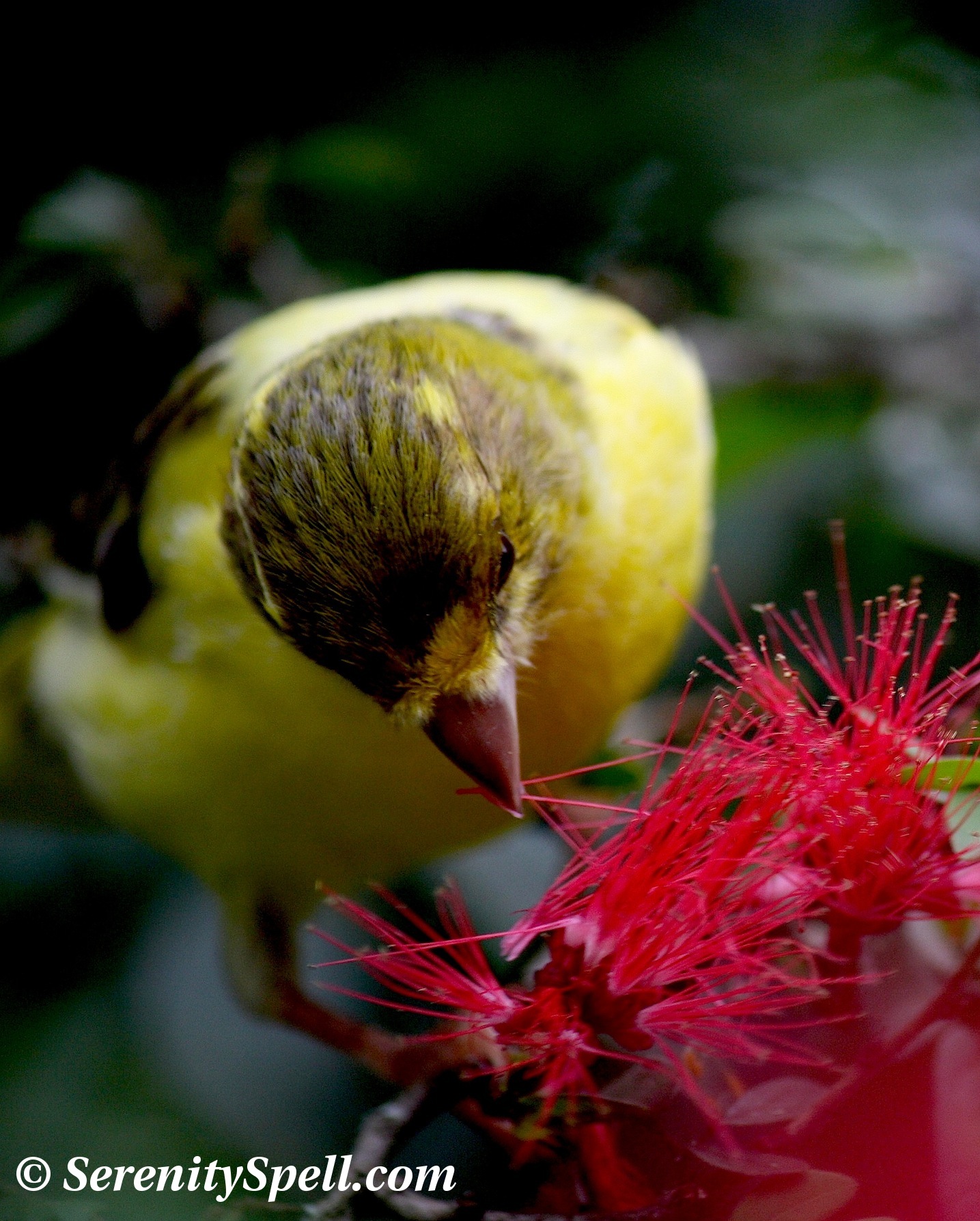
Wild Canary Enjoying a Red Powderpuff Plant

Wild Canary Enjoying a Red Powderpuff Plant

Wild Canary Enjoying a Red Powderpuff Plant

 FeyGirl
 Serenity Spell