Skip to content

Weekly Photo Challenge: Delicate

Well, this was my initial DELICATE post — a precious periwinkle dragonfly resting along the Apoxee Trail in the Grassy Waters Preserve.  It was my companion for the better part of a half-mile; this gossamer creation following me as I hiked — perhaps because I was head-to-toe in periwinkle!

Blue Dragonfly, Grassy Waters Preserve, Florida

That is, until Sunday evening, when a starving black kitten crossed my path. I’ve been TNRing (Trap-Neuter-Release) many kitties, in my wee attempt to help control the populations. (Our county has a severe feline overpopulation issue.) Apparently a lovely woman nearby is doing the same (THANK YOU, stranger!). Sometimes, it’s not cheap: If the kitties are sick, pregnant, need medications, or if assistance is needed with trapping (they can be wily)…it quickly adds up. But these guys need help. Many have been abandoned, the sad products of foreclosed homes and other circumstances. I’ve seen pets left behind for a simple move / long vacation, shockingly.

New Feline Rescue

Maya (??) caught in the flash

My guys are rescues…. And it’s easy to see which ones can survive out there, and which ones cannot. This girl falls into the latter category. She tried desperately to find a home for as long as she was alive, apparently. Maya (?!? still playing with her name) crossed my path in another section of the neighborhood, and, according to one of the tenants, she has no litter mates, and was unable to reach the food provided by the woman caring for the other strays (being so tiny and timid). She had been trying to sneak into the homes of many residents — to no avail. An absolute sweetheart, one of the friendliest felines I’ve ever seen, she wants nothing more than love, safety, and shelter. But every bone in her body is razor-sharp: each vertebrae, her hips…. She was starving. At 6 months old, she has the body of a 4-month-old. I’ll never understand how a starving animal could be repeatedly turned away by so many, nor do I want to understand.

New Feline Rescue

Enjoying the view from inside

Right now, while her body’s very delicate, she’s a survivor — like so many souls on the streets, she’s a combination of delicacy and strength. And despite what she’s seen, despite her physical hardships and emaciation, despite her continued unsuccessful attempts at finding a home (until now), she remains the sweetest little soul.


Audubon of Florida

A growing number of people are demonstrating respect, love, and passion for conservation and the environment in general, something I firmly believe this most beautiful blue sphere of ours, and its lovely inhabitants, needs en masse. And there are organizations that pull together these wonderful passions, using them for the greater good. Audubon is “Florida’s oldest conservation organization, protecting birds and wildlife for more than a century”. Through Audubon of Florida and their Conservation Network — a powerful and knowledgeable grassroots network of citizen advocates — you can access up-to-date information on the state’s conservation issues, and receive calls-to-action during critical decision-making times. There’s an incredible amount of information and resources: free and timely e-newsletters and fact sheets (including the Everglades Conservation Network’s Restore, the Florida Conservation Network’s Advocate, the Climate Action Network’s Climate Solutions, the Center for Birds of Prey’s Raptor News and the Coastal Strand). Regular reports of Florida conservation issues are provided, as are ways to help.

Great Egret in Breeding Plumage, Florida Wetlands

Great Egret in Breeding Plumage in the Protected Wetlands

Continue to love, enjoy, and work to preserve this most amazing environment, ensuring that the devastatingly high habitat loss in the Everglades and in other endangered ecosystems throughout Florida is reversed. Not all have the planet’s protection in their best interests — money still rules, and development and sprawl are devastating. But with Audubon’s tools and resources, you can help conserve Florida’s environmental future: its water resources, land, and birds and other wildlife.

National Audubon Society Logo — The Great Egret in Flight (Courtesy of The National Audubon Society)

Visit Audubon of Florida, their news blog, and the organization’s plethora of information and educational resources. It doesn’t take much to be an advocate and supporter of this state’s incredible and unique ecosystems. Or, just run to one of Florida’s more than 2,000 natural spaces and national parks (two THOUSAND) — there are so many amazing places to love and support, and by simply visiting, enjoying their beauty, you’re helping to protect them.

And for the Facebook followers: Audubon Florida on Facebook

Protect my land…!

Baby Alligator in the Florida Wetlands

Baby Alligator in the Protected Wetlands

Or…where would you be able to see my beautiful mug?

Sunning Alligator in the Florida Everglades

Sunning Alligator in the Florida Everglades

Wail of the Limpkin

Floridians know their cries well. And if you live near water, it’s always a lovely wake-up call, this startling wail. Their wail is the sound of the Everglades and of Florida.

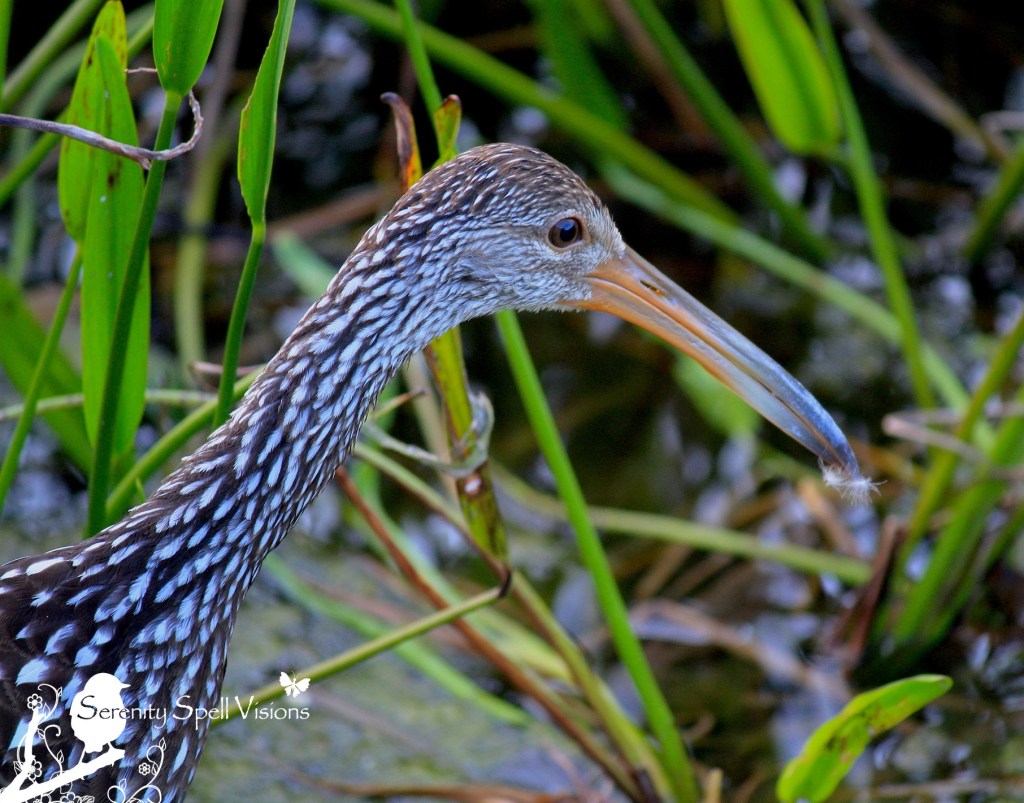
The Limpkin (also called carrao, courlan, and crying bird) is found primarily in wetland habitats, from Florida to northern Argentina. While doing well in areas south of here, this bird is considered SCC — a species of conservation concern — in Florida. This, due to the severe decrease of its primary diet — more on that later — but there is hope for these sweet birds. As with other natural wanderers, I’m seeing them feeding in more creative areas, including canal banks. They’re adapting to their habitat loss, hopefully. Here’s to restoring more of their land, and continuing to protect it for future generations.

Limpkin, South Florida

A Limpkin rests precariously close in the alligator-infested waters of Grassy Waters Preserve

Limpkins inhabit freshwater marshes and swamps, as well as mangroves. The bird averages 25–29 inches in length, and boasts a wingspan of 40–42 inches. Primarily nocturnal, Limpkins are strong flyers and swimmers, and with their long toes, they are able to stand on floating vegetation — which also makes them easy prey for alligators. They wade and forage in the shallow waters, seldom submerging themselves more than halfway. Look for them probing for food in the clear waters, amid the vegetation.

These birds feed primarily on molluscs, and insects, frogs, lizards, and worms when needed. But their diet is dominated by apple snails, which the bird’s bill is perfectly adapted to, since it acts like tweezers. The best way to find Limpkins is to find apple snails — rarely broken in the quick feeding process, these giant snails are a sight unto themselves. Apple snails include species that are the largest living freshwater snails on planet Earth. They’re big.

The survival of the Limpkin depends on these snails — everything is intertwined in Nature. Disturb one facet, a chain reaction quickly begins, and all is upset.

Apple Snails, Riverbend Park

Limpkin Leftovers: Apple Snails in Riverbend Park. Or, as I call them: Giant Alice-in-Wonderland Snails

Fun Facts:

    • The Limpkin’s name is derived from a perceived limp when it walks.
    • These birds — Aramus guarauna — are the only surviving species in the genus Aramus and the family Aramidae.
    • Recent DNA studies have validated a close relationship with cranes, although the Limpkin is often confused with the immature American White Ibis.
    • The Limpkin’s cry is infamous: It has been used for jungle sound effects in the Tarzan films, and for the hippogriff  in the film Harry Potter and the Prisoner of Azkaban.
    • Want to hear the echoing cry of a Limpkin, so very common to our area? Click here!
Limpkin, South Florida

Limpkin ready for his close-up in the protected wetlands

Part of:

Perfection and beauty in truth….

Pat Cegan's avatarSource of Inspiration

owl2

Nothing separates you
and I from our Creator.

View original post

A Personal Face to the Date Which Will Live in Infamy: Dec. 7, 1941

On December 7, 1941, my beautiful, kind, and brave grandfather was in Pearl Harbor, far from his Indiana country upbringing.

CCI00004 copy

My handsome grandfather hamming it up in Pearl Harbor (on the left)

Before that infamous day though, the men — and their gals — enjoyed some downtime in tropical Oahu.

CCI00005 copy

Hubba hubba: My grandmother, or the little island girl

My granddaddy was a Lieutenant aboard the USS Montgomery, a destroyer located near the entrance to Pearl Harbor when the bombers attacked. The ship wasn’t fully crewed, but it managed to depart to sea immediately, due to its location. The Montgomery eventually received four battle stars for World War II service.

Later in WWII, my grandfather took part in the Pacific Theater — ironically, in the area where I grew up, the Kwajalein Atoll — contending with the high seas of the South Pacific and kamikaze pilots.

0512104

USS Montgomery, my granddaddy’s first post — caught at Pearl Harbor

Photo Courtesy of NavSource Naval History

He eventually became Commander of the USS Shea, another destroyer. During periods of the war, the Shea was in constant engagements with Japanese aircraft. At one point, all communications were lost. To imagine being on a listing ship, with so many dead and dying fellow men, your communications completely lost, out in the vast empty waters of the South Pacific… This is what I think of when I meet veterans today.

In 1954, the Shea took part in the atomic tests conducted at Eniwetok Atoll in the Marshall Islands (my stomping grounds). Regardless of these feats, my grandfather remained the most gentle soul till his death at an excruciatingly young age — I’m convinced due to the close exposure of radiation. To this day, 32 years after his passing, he remains my guiding force. James Walter Reed led his crew with an inherent gentleness and strength — a combination so very rare to the human species.

CCI00007 copy

The USS Shea, my granddaddy’s Commander post

CCI00006 copy

Commander Granddaddy visits the officers of the USS Shea in 1953

Both he and my grandmother are now laid to rest at the breathtaking Arlington National Cemetery. May this day continue to live in infamy, and never be forgotten — may the heroism of so many always be remembered. And may these days of remembrance serve to teach us lessons of loss — and futures of peace.

And finally…. Early happy birthday to you (tomorrow, the eighth), granddaddy.

grandmommy & granddaddy

Grandmommy and Granddaddy in San Francisco, during a lucky break: LOVE.