Skip to content

Posts tagged ‘animals’

Creating Our Backyard Wildlife Habitat: Step One, Provide Food

There have been many wonderful comments from people explaining how they’re creating natural habitats for their wildlife critters in their personal spaces (usually birds, but not always) — some of whose populations have suffered a decline in recent years. It’s crucial in our modern culture/society to do so; It doesn’t take much to provide a wee bit of food, water, and shelter for these guys…. Besides, it calms the soul to view nature. ♥

Here, Nature Mom teaches her son how to create a backyard wildlife habitat, something anyone can do, in any environment — I had a great little set-up in a former apartment. Following guidelines provided by the National Wildlife Federation (NWF), she details the creation and necessary resources for her local wildlife….

Linda Bernardi's avatarSuburban Nature Explorations

Today my son and I began working towards making our backyard into a Certified Wildlife Habitat, per the guidelines provided by the National Wildlife Federation (NWF). I figured it would be best for my four-year-old if we only focus on one aspect of certification at at a time. Our focus today? Step one: Provide Food for Wildlife.

Certification requires that the backyard provide three food sources, selected from the following list:

  • Seeds
  • Nuts
  • Berries
  • Fruits
  • Nectar
  • Sap
  • Foliage / Twigs
  • Pollen
  • Supplemental Feeders
    • Seed
    • Suet
    • Hummingbird
    • Squirrel
    • Butterfly

This was a fun, educational activity to work through with my son. What in our yard is food for wildlife? What could we add that wildlife could eat? What animals might eat each of the items on this list?

We decided our yard provides nuts (acorns from the oak tree), nectar (the rosemary flowers), and seed (supplemental bird feeders). We…

View original post 126 more words

Creating Our Backyard Wildlife Habitat: Step Two, Supply Water

Step 2 in the guidelines set forth by the National Wildlife Federation (NWF), in the creation of a backyard wildlife habitat: Supply Water!

Linda Bernardi's avatarSuburban Nature Explorations

For those of you who are following us, you know that yesterday my son and I started to create a wildlife habitat in our backyard, following the guidelines set by the National Wildlife Federation (NWF). Yesterday our focus was on providing food sources for wildlife. Today, we worked on step two… supply water for wildlife.

Certification requires that the backyard provide one water source, selected from the following list:

  • Lakefront
  • Seasonal Pond
  • Coastal
  • Birdbath
  • Water Garden / Pond
  • Rain Garden
  • Lake
  • River / Stream
  • Spring
  • Shallow Dish
  • Puddling Area

In the past, providing water in our yard for wildlife wasn’t something I thought about. Actually, my focus was on emptying out any little bit of pooled water I could find, as I don’t want any mosquitoes breeding in the yard. Also, there is a natural spring just on the other side of our fence, which is primarily what attracts…

View original post 184 more words

Creating our Backyard Wildlife Habitat: Step Three, Create Cover

Step 3 in the National Wildlife Federation (NWF)’s guidelines in the creation of a backyard wildlife habitat: Create Cover!

Linda Bernardi's avatarSuburban Nature Explorations

Today was day three of working towards making our backyard into a Certified Wildlife Habitat, per the guidelines provided by the National Wildlife Federation (NWF). So far, we’ve completed step 1 (provide food) and step two (supply water).  Our focus today? Create cover for wildlife.

This step in the certification process requires that a backyard has two types of cover for wildlife, selected from the following list:

  • Brush Pile
  • Log Pile
  • Wooded Area
  • Dense Shrubs / Thicket
  • Meadow / Prairie
  • Evergreens
  • Ground Cover
  • Roosting Box
  • Water Garden / Pond
  • Bramble Patch
  • Burrow
  • Cave
  • Rock Pile / Wall

This one was a bit tough for us, though my son had fun trying to build cover with the many sticks he’s collected over the years (photo below). We definitely already have one major cover for wildlife… our deck. But “deck” isn’t one of the items on…

View original post 199 more words

A Calm Cormorant

At our protected Green Cay and Wakodahatchee Wetlands, where nesting and baby season remains in full swing (granted, the babies are growing, but there are some late-arrival nesters), some of the year-round residents don’t seem overly concerned with the consequent increase in human traffic. With more than 140 species of birds identified at Wakodahatchee, and the fact that it’s part of the Great Florida Birding Trail, the site is a birdwatcher’s and photographer’s paradise — especially now. I like to stroll towards the back of the boardwalk to admire some of the shyer inhabitants — and consequently avoid the chaos of the human visitors during this time of the year, when the wetlands’ newest residents are on display.

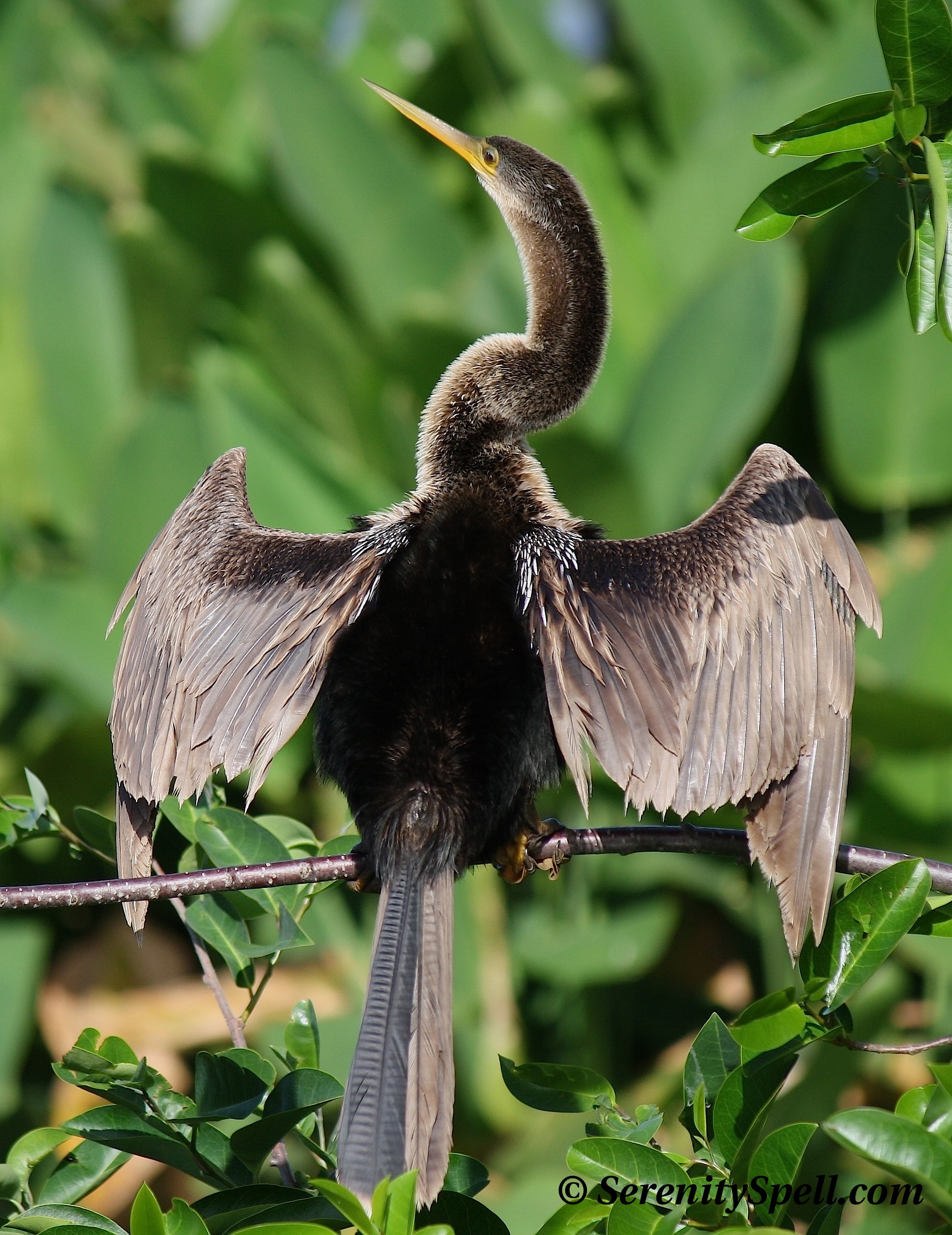
Anhinga Dries Its Wings

A noticeably calm cormorant — or “shag” (referring to the bird’s crest, which is lacking in the British forms of the Great Cormorant) — was preparing for a nap at the end of the boardwalk. These medium-to-large coastal (rather than oceanic) seabirds are plentiful in southeastern Florida, and can often be seen diving for fish or water snakes. After fishing, the cormorants dry their wings ashore in the sun or in the trees (similar to the cormorant-like anhingas), as their feathers don’t possess the waterproofing oil of other seabirds.

Humans have long used trained cormorants to fish the waters of China, Japan, and Macedonia. Trained by fishermen, a snare is tied near the base of the bird’s throat, allowing the bird to swallow only small fish. When the bird captures and tries to swallow larger fish, the snare doesn’t allow the fish to be swallowed, and it becomes stuck in the bird’s throat. The cormorant is forced to return to the fisherman’s boat, where he helps the bird regurgitate the fish, removing it from its throat. Traditional cormorant fishing isn’t as common a method today — with the development of more efficient fishing methods — but it remains a tourist draw. However, the method is still practiced in some Japanese regions, and has continued uninterrupted for 1300 years in Gifu City, in Gifu Prefecture.

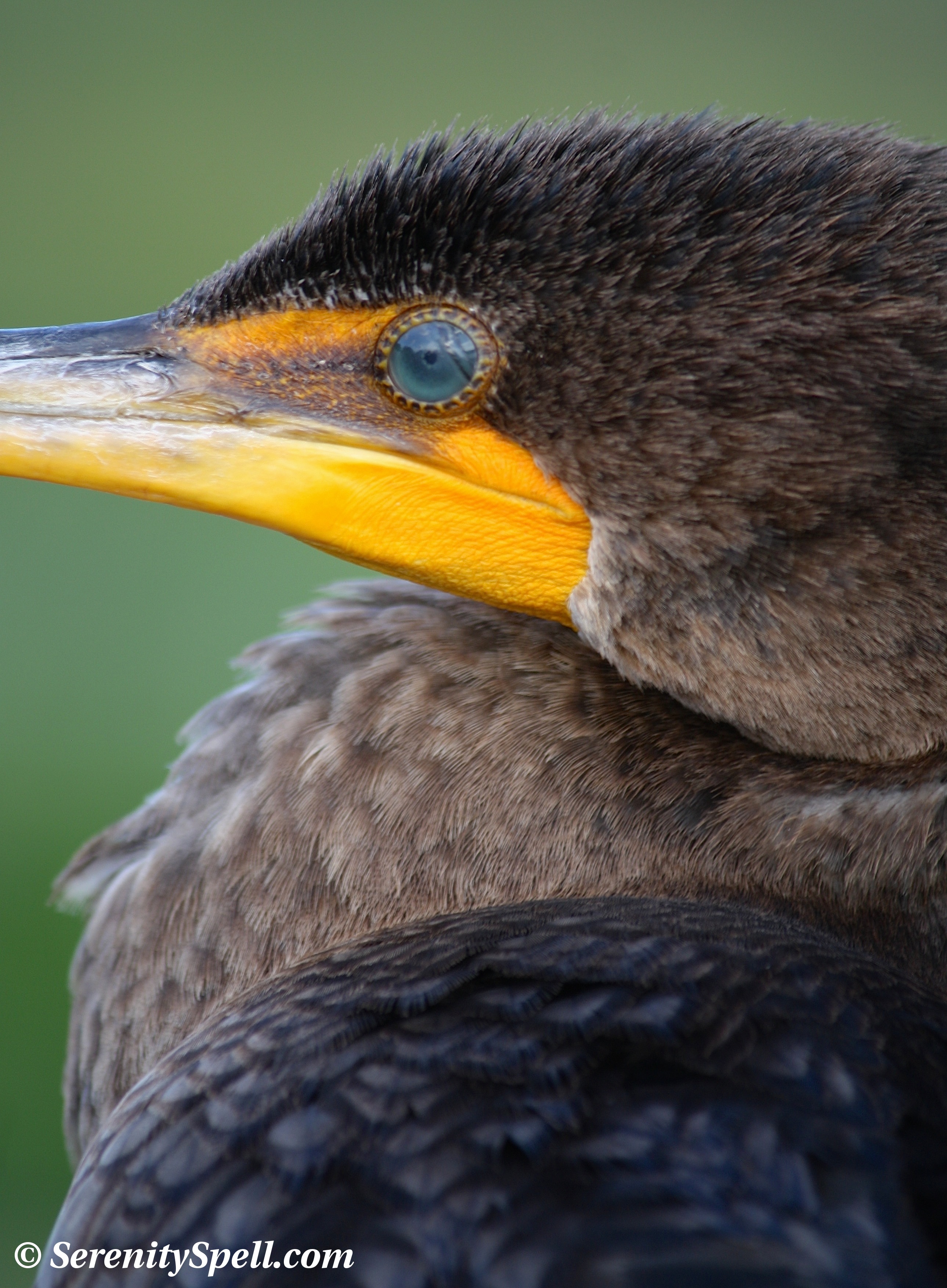
Although both cormorants and anhingas are quite common in our area, I was struck by the serenity of this guy, and his beautiful teal eyes…. Their distinctive turquoise eyes fade quickly after the breeding / nesting season.

Lovely Teal Eyes of the Cormorant (Florida Wetlands)

Sharp Beak of the Cormorant (Florida Wetlands)

Dozing Cormorant in the Florida Wetlands

Safeguarding the Animals

Our task must be to free ourselves… by widening our circle of compassion to embrace all living creatures and the whole of nature and its beauty. -Albert Einstein

Whenever I become forlorn at the state and plight of animals — be it habitat loss, animal cruelty, or negligence — I’m constantly reminded of the most amazing and bright souls who give so much of themselves to creatures in dire need:

  • Puss, One of Our Feline Rescues, Nabbed from a Field

    Volunteers who, in their precious spare moments away from family and work, run to the most absurd places to catch feral cats — TNRing them (trap-neuter-release) to control feline overpopulation

  • Those making regular excursions deep in the Everglades to rescue dogs and cats that have been heartlessly abandoned in the middle of the swamps (more on this wonderful, growing group — 100+ Abandoned Dogs of the Everglades Florida — later)
  • Blythe Spirit (formerly "Zero"), Our Sweet Rescue — Always With Us

    All the crucial, hardworking efforts of groups rescuing horses in the midst of the president’s and Congress’ recent restoration of the horse slaughter industry in this country (more on this later, from a personal horse rescue perspective)

  • Just Friday evening…. Nancy Grace highlighting the plight of NYC’s abused and overworked carriage horses (something I’ve long been tracking); profuse thanks for bringing this issue to the national stage
  • Late last week, “dungeon” chimpanzees, caged their entire lives in tiny cells for experimentation, freed and transported from the Coulston Foundation research facility in Alamogordo, NM to a sanctuary in Ft. Pierce, FL by the group Save the Chimps — and feeling grass for the first time in their long lives. Read more, and watch the touching CNN video here.
  • Teaching a Shelter Dog to Play: My Brother's 6-Yr-Old Rescue, a Retriever Finally Learning to Run and Retrieve...

    The countless individuals and organizations rescuing, rehabilitating, and finding homes or releasing animals of all varieties

  • And the list goes on…. Far too many inspiring people and groups to mention here, even in my region alone (I recently wrote about our trip to the Everglades Wildlife Sanctuary and Aviary of South Florida’s Flamingo Gardens — a site worth visiting)

A recent post by Pat Bean on her blog Pat Bean’s Blog provided yet another most amazing reminder of these profound efforts to help those with no voice. Read about Thomas Young and his small zoo and wildlife sanctuary — Queen Wilhelmina State Park — near Mena, Arkansas. Learn about the rescue and rehabilitation of thousands of bears, hawks, owls, eagles, and countless small mammals into the wild…. And how even the wild animals flock to him. Sadly in my efforts to find out more information about Mr. Young, his sanctuary had suffered at the hands of Mother Nature, and he himself was confined to a wheelchair with Rocky Mountain Spotted Fever (after a tick bite). Unfortunately I couldn’t find much else — save this site, which I believe is the sanctuary. This was 2009; one can only hope that Mr. Young has returned to his healthy self, and the sanctuary and resident animals have his love and expert help. May his work continue to inspire future wildlife rehabilitators.