Skip to content

Posts tagged ‘nature’

Paying It Forward: A Giveaway Contest!

I doubt these juvenile cattle egrets are actually enjoying each other’s presence — they’re most likely fighting for nest dominance — but for our purposes, it’s gifting-time!

Arguing Juvenile Cattle Egrets in the Florida Wetlands

I thought this was a wonderful idea, forwarded by Long Life Cats and Dogs — who in turn was shared it by another blogger. THANKS! So I’m now paying it forward with a giveaway-contest. I LOVE the idea of giving back to such a generous, kind, and talented group of people. Besides, making, giving, and receiving = FUN!

The first three people to comment on this post will receive a gift, a little homemade something, with our Everglades at heart (of course, no critters were harmed in the making of said gift).

The fine print:

  • Within a year, I’ll create something unique to share with the first three people to comment on this post. (I promise it won’t take me an entire year!)
  • In order to receive your gift, you must play along. Spread the love on your own blog, promising to send a little special something to the first three people who comment on your post. Pay it forward!
  • You get 72 hours to re-post, or I’ll move on to the next person. Sorry, apparently there are RULES.

So if you’d like a little something from our Everglades, comment below! And please — if you’re not willing to pay it forward, or if you don’t want something nature-based, created by an Earth-loving-slightly-hippy-hiker, I would hesitate…. ♥

Our Snakes Swim! And: Learn How to Spot a Non-Venomous Water Snake


The love for all living creatures is the most noble attribute of man. ―Charles Darwin

We have lots of snakes in South Florida, in the Everglades region — and like other parts of the country, most are non-venomous, with a few poisonous critters thrown in for good measure. The Cottonmouth, Rattlesnake, and Coral Snake are Florida’s more notable poisonous snakes — but there are only 6 species that are venomous and a known danger to humans. SIX! The remaining are non-venomous, and vital members of our ecosystem.

Banded Water Snake, Florida Wetlands

But if you’ve seen the Discovery Channel of late — or the History Channel’s “Life After People” series — you’ll know of the Everglades’ relatively new and constant battle with pythons. In fact, just recently on August 15, the biggest python was captured in the Everglades National Park — a female measuring 17 feet, 7 inches, and carrying 87 eggs. WHOA. Wrap your head around that size (and egg quantity) for a moment. While she broke records, these invasive pythons continue to wreak havoc on native Everglades wildlife; these snakes that were brought to Florida as a result of the relaxed regulations in the trade of exotic reptiles are decimating the local populations of a sensitive and threatened ecosystem onto which they were set free.

But fortunately, I didn’t see her; I saw water snakes during our last venture! This guy is a common water snake in our area — the Florida Banded Water Snake. They prefer freshwater habitats, and can be found in the shallow waters of wetlands, swamps, marshes, ponds, lakes, streams, and rivers. They’re native to the peninsula, and to the extremities of southeastern Georgia, and feed on live and dead fish and amphibians. Like other snakes, the Banded Water Snake plays a vital and significant role in our ecosystem. As predators, they feed on a variety of creatures, and can control the rodent populations. Snakes are also important prey for other species of predators. The presence or removal of snakes from any area affects the overall health of many ecosystems — and continued development threatens snakes’ survival.

I see a swimming ssssnake!

Lovely stripes of the Banded Water Snake

Many people automatically assume water snakes are venomous — this is actually far from the truth. Most, nearly all in fact, are harmless and non-venomous to humans — although like any wildlife, they have a mouth full of teeth, and will bite to defend themselves. Sadly, many of these perfectly harmless snakes are killed by ignorant humans — so to avoid any confusion, here’s an easy way to distinguish non-venomous water snakes from the Cottonmouths:

  • Water snakes’ eyes can be seen from the top of the head — as in the picture below — while you can’t see the eyes of Cottonmouths from above
  • Water snakes’ pupils are round, while those of the Cottonmouth are vertical and cat-like
  • There is no facial pit on the side of the head between the eye and the nostril with water snakes — but there is with Cottonmouths
  • The tops of water snakes’ are more rounded, while those of Cottonmouths are flat and triangular

Feeling my way around; Look at my eyes…

We often encounter snakes on our hikes — water and land snakes. Sometimes, we’re not sure if they’re venomous, and we ALWAYS leave them alone. Well… Except for the hurt Cottonmouth in the road we saved. And those snakes we knew to be non-venomous, like the very large Brown Water Snake that somehow ended up in my interior closet (how he got there, I’ll never know…?). Even the kitties were frightened of that poor scared — and massive guy.

Most snakes aren’t aggressive and will flee when humans approach, so they’ll only defend themselves — striking out or biting — if they’re feeling cornered, threatened, or are handled. An inordinate amount of snakebites are on the hands and arms, due to handling snakes. Be smart, and above all else — be respectful of wildlife and their land.

Banded Water Snake, Florida Wetlands

Visit the blog Hinterland Village Resort, for a post on A Snake Rescued in India!

Fun Fact:

Unlike land snakes, which lay eggs, the Florida Banded Water Snake bears live young! Mating occurs during the mid-winter and spring, and litters of 20 – 30 young are born in the late spring through summer. Baby Banded Snakes are 7 – 10 inches at birth.

Goodbye to You, Isaac!

Since Friday evening, we felt Isaac’s feeder bands with increasing force — Sunday and Monday were particularly…”active.” If you haven’t witnessed a tropical storm, hurricane, or their feeder bands, it’s a most amazing and beautiful sight — to stand in the open and watch a storm’s dark feeder clouds rapidly circling around you. The sheer force and expanse of these storms is awesome, and can put things in perspective.

However, I’m particularly grateful today, given our flooded neighborhood and city, that I freelance / work from home — GRATITUDE!

Flooded cul-de-sac

A new lake in the cul-de-sac! The other streets were equally…damp

And on another bright spot, the fish and ducks are VERY happy with the extra real estate.

Thanks St. Francis, for keeping those waters just a few feet from our little home….

A Motled Duck surveys her newly expanded lake

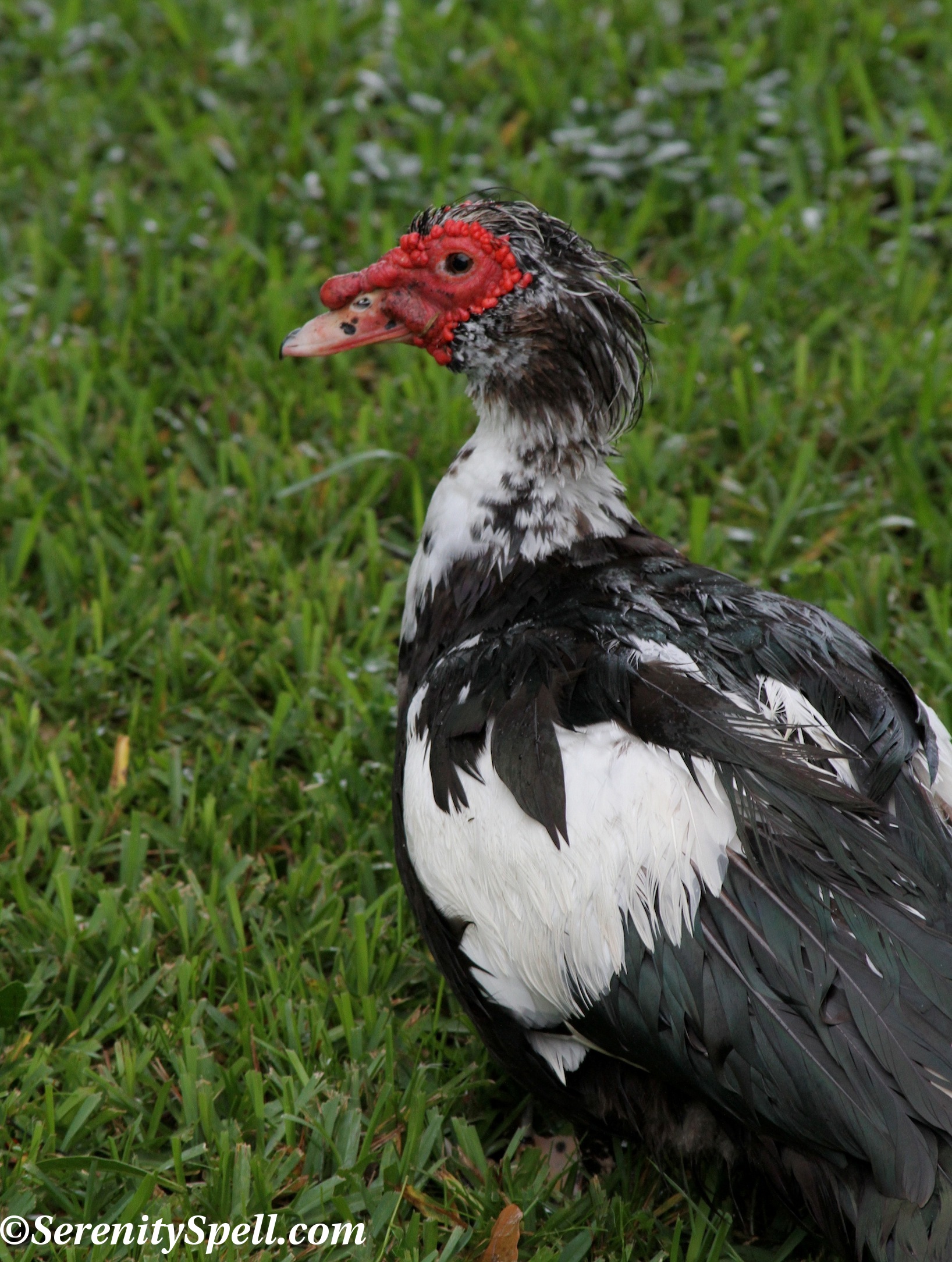
A happy Muscovy Duck eating at the water’s edge — near the house

An anxious Mouse surveys the lake, staying far above the flooded porch floor

Now, sending good wishes and love to the northern Gulf Coast, as a strengthening Isaac approaches on Katrina’s anniversary.

Watching the Divine

Stranger

by Thomas Merton

When no one listens
To the quiet trees
When no one notices
The sun in the pool.

Where no one feels
The first drop of rain
Or sees the last star

Or hails the first morning
Of a giant world
Where peace begins
And rages end:

One bird sits still
Watching the work of God:
One turning leaf,
Two falling blossoms,
Ten circles upon the pond….

(For complete poem, click here)

Deep in a swamp of the northern section of our Everglades, we spied this solitary Great Blue Heron relaxing on a fallen log. Far in the SWA Trails of the Grassy Waters Preserve — along the outer Owahee Trail — there was little to disturb her. She remained there on our return trip, hours later — at complete peace in the beautiful remnants of this most amazing and completely unique ecosystem.

Here’s to hoping that Mother Nature is gentle on Florida, and that Isaac gives us nothing more than nice winds and rains. A shift to the west would be extra kind, to provide Texas with some much-needed rain…. In the meantime, there are many brave and wonderful people working overtime in preparation for the upcoming storm — including 100+ Abandoned Dogs of Everglades Florida. This group rescues dogs, abandoned and left to fend for themselves in the harsh wilderness of the Everglades (along with cats and even horses). They provide these animals desperately needed medical attention (many are starving), and find foster and permanent homes for them. Much luck and love to these volunteers.

Green Heron Hunting

Do whatever you do intensely. —Robert Henri

I encountered this Green Heron — one of my favorites in our wetlands — perched high in the beautiful cypress trees, stalking its dinner during the approaching dusk. He sat with such intense focus (that face!), that I admired in silence for the entirety of his watch.

But this guy wasn’t just watching; he was most likely waiting. Green herons will often drop bait onto the water’s surface — including live insects, berries, twigs, or feathers — to attract fish. The more curious the fish…the more likely they’ll be dinner at the quick thrust of the heron’s sharp bill. This hunting technique, and use of tools, has earned Green Herons the well-deserved distinction as one of the world’s smartest birds.

When I hear their signature kuk or kyow, I search for these shy guys and their moppy crowns, in the hopes of catching them hunting. Click here to listen to their calls!

Green Heron hunting in the wetlands… FOCUS!

Green Heron eyes a meal in the wetlands… PATIENCE!