Skip to content

Posts tagged ‘wildlife’

A Tiny and Striking Owl Finch

The love for all living creatures is the most noble attribute of man. ―Charles Darwin

The Owl Finch — Bicheno Finch, or Double-barred Finch — is native to Australia, and can be found in open savannah-like habitats. The “owl” part of this tiny and striking finch’s name is due to the dark ring of feathers around an otherwise white face. The rest of these finches sport black and brown on their upper bodies and throats, with white underneath. A black band divides the breast from the throat, with another black line dividing the chest from the belly area. Their wings are mostly black, layered with speckles of small white uniform dots.

Owl Finches are known to be friendly, and interact well with mixed species — and sure enough, these handsome little finches were twittering about the lush and fairy-like Butterfly World’s Jewels of the Sky Aviary, the largest free-flight hummingbird aviary in the United States — even cohabitating with the butterflies.

Owl Finch

Owl Finch Displays Its Lovely Wing Patterns

Owl Finch and Its Striking Facial Markings

Look Closely…

I was so focused on a songbird on this tree’s branch, that I barely heard my guy gasping, in a barely audible whisper…. “Ohmahgawd. You’re gonna freak.” I love frogs — well, I seem to say that about everything — but I do love them and appreciate their vital role in our ecosystems.

I couldn’t even see what he was pointing at — did I need my spectacles? I had my telephoto lens working hard, so as to not disturb the bird. I quietly crept up to the trunk, and there it was: a tiny frog — he had to be two inches, at the most — nestled comfortably in the depths of a knot within the tree’s trunk. My eyes quickly became bigger than the knot itself.

I’m continually amazed at how much life trees support — seen and unseen.

Instructions for living a life.
Pay attention.
Be astonished.
Tell about it.
—Mary Oliver

A Tree?

Tree Frog… Closer…

Tree Frog Face… Peek-a-boo!

Yellow on Red: Wild Canaries & a Powderfuff

Nature does not hurry
Yet everything is accomplished. —Lao Tzu

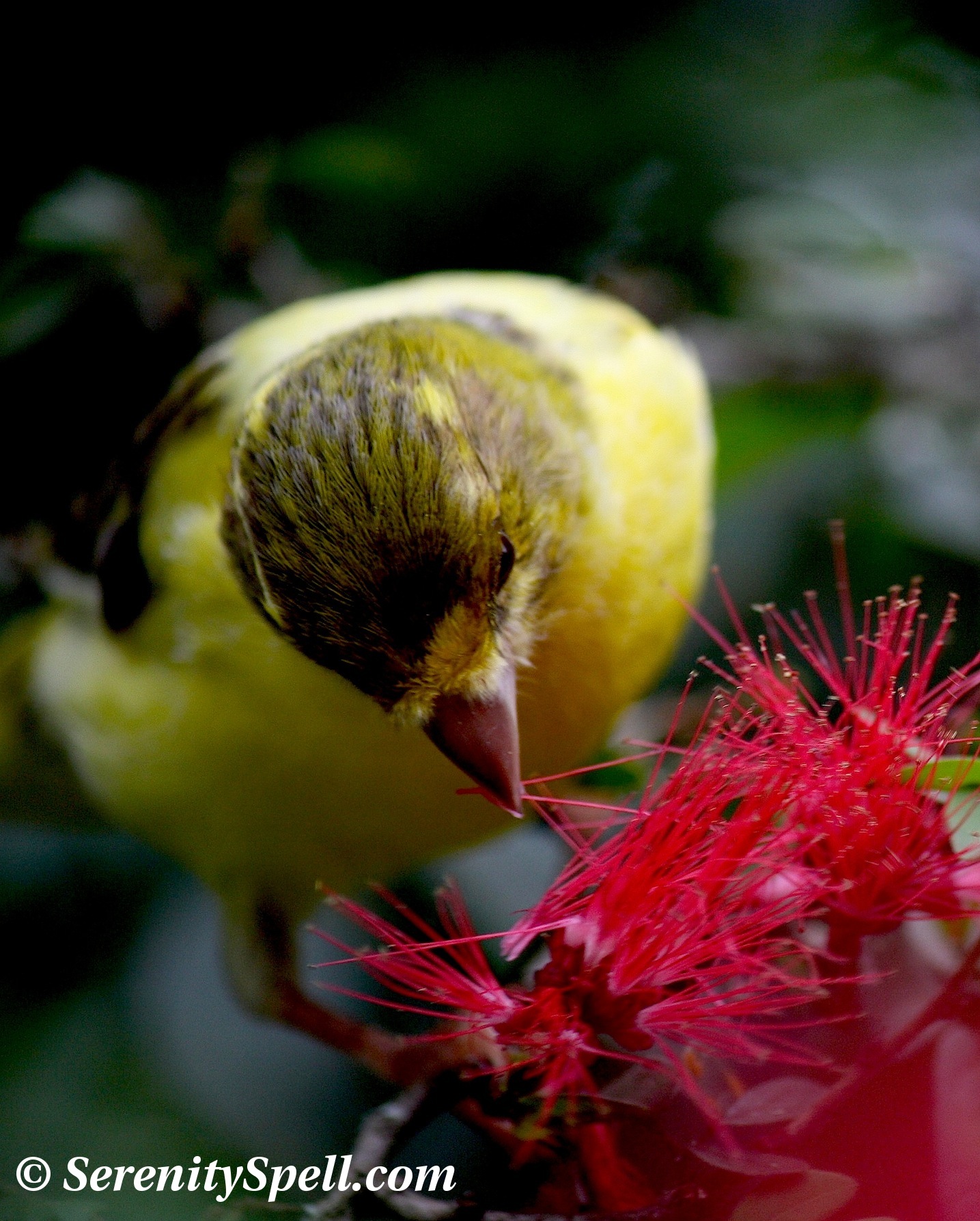
The Wild canary (Serinus Canaria) — Canary, Common Canary, or Atlantic Canary — is native to the Canary Islands, the Azores, and Madeira. These wild birds are mostly yellow-green, with brownish streaking on the back — similar to a sparrow in size and markings. It belongs to the finch family.

The bird is named after the Canary Islands, derived from the Latin Canariae Insulae, meaning “Islands of Dogs.” They were so named by the Romans, in honor of the islands’ native inhabitants breeding large dogs. So the word “Canary,” derived from the Latin Canis, means “dog.” The Spanish conquered the islands in the late 1400s, and returned to Europe with the yellow songbirds. From there, Italy, Germany, France, Belgium, and later the U.S. bred their own versions of these colorful little birds, primarily for their sweet song. Germany became the center for breeding canaries, and for training them to sing. They were so widely bred, that by the beginning of the 18th century, 29 distinct varieties were already in existence. Today, the species is common in captivity, with myriad color variations — and breeders striving for more color, song, and physical diversity. But taking a peek at the original Wild canary, it’s difficult to find similarities to the bright yellow counterparts you may encounter today. Personally, I find them that much lovelier.

During mining’s heyday, canaries were taken deep into coal mines to detect gases; being sensitive, they would soon die if gases were present. On that note, I give you The Police’s Canary in a Coal-Mine, a great ditty that’s been in my head for days, understandably….

This golden beauty was twittering about the lush and fairy-like Butterfly World’s Jewels of the Sky Aviary, the largest free-flight hummingbird aviary in the United States. He finally settling on a Red Powderpuff plant (Calliandra haematocephala). Red Powderpuffs are subtropical shrubs/trees that are easy to grow (and not just in Florida, but they do grow LARGE here), and even better… They’re attractive to bees and butterflies — and obviously birds!

May your weekend be as golden and bright as this lovely little songbird!

Wild Canary Enjoying a Red Powderpuff Plant

Wild Canary Enjoying a Red Powderpuff Plant

Wild Canary Enjoying a Red Powderpuff Plant

Wild Canary Enjoying a Red Powderpuff Plant
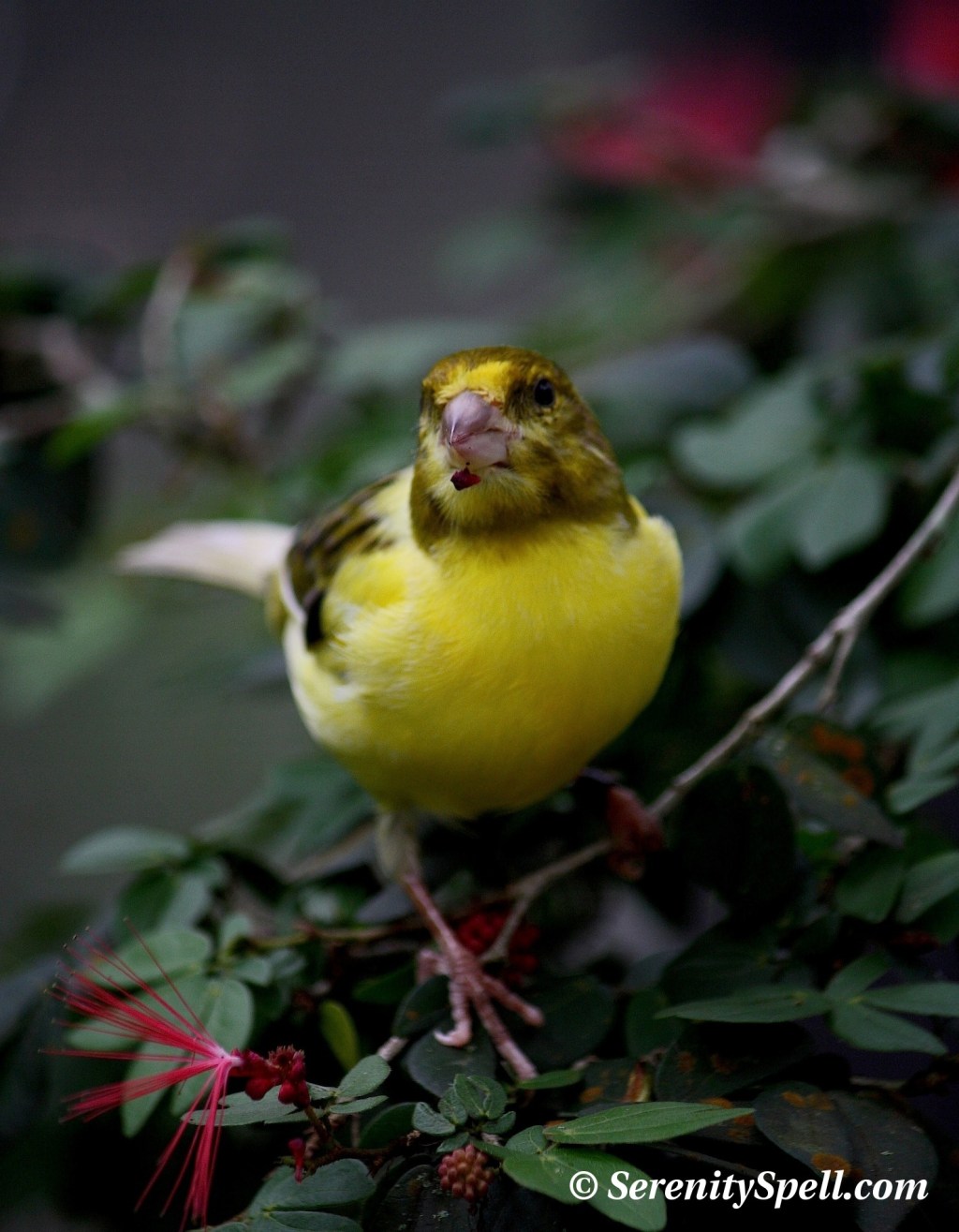
Wild Canary Enjoying a Red Powderpuff Plant

Wild Canary Enjoying a Red Powderpuff Plant

There’s been much talk of the upcoming oil drilling in the Arctic. Drilling creates an even stronger greenhouse effect; risks disaster to this pristine land; and disrupts whale movements with its added noise. Greenpeace’s petition has been widely distributed (see the last paragraph of the post for the link), but I thought Mr. Drost’s words summed it up beautifully. PROTECT and PRESERVE what little remains…. Enough is enough is enough.

Arjen Drost's avatarNatureview photography

This summer the Dutch/British owned oil company Shell will start drilling for oil in the Arctic. They can do this because the sea ice has melted enough to expose the oil rich sea floors of the high north. This oil will be burned, resulting in more carbon dioxide in the atmosphere and an even stronger greenhouse effect… Besides, we’ve seen in the Gulf of Mexico what can happen when something goes wrong while drilling for oil. And with the cold temperatures oil degradation takes much longer as in the warmer Gulf of Mexico.

Since I came to the high Arctic for the first time in 1999 I’ve seen islands emerge from glaciers, I’ve reached places that used to be locked in ice every summer and I’ve seen Polar Bears change their behavior because of the changing ice conditions. When I made my first visit I expected to visit a true…

View original post 100 more words

A Young Great Blue’s Meal

I had been watching one of the Great Blue Herons at our local wetland preserves a few weeks ago; she only had one baby, which is a bit unusual for the species. I watched as she built her nest high in the cypress trees, then dutifully guarded it, alone…. There was no male in sight, which is likewise unusual. Usually both the male and female remain at the nest, and hunt for the young. There aren’t as many human visitors at these particular wetlands, due to the lack of active rookeries — which suits me just fine; the baby alligators, birds, butterflies, marsh rabbits (or swamp bunnies as I’m fond to call them), and if I’m lucky, bobcats, keep me company.

I always spied this Great Blue hunting in the same area — a swath of dry land near a small swamp frequented by the bobcats. Visitors would stroll right by her, she blended so perfectly with the landscape. This choice of hunting grounds would explain her meal below — Yummers! It’s no surprise that these birds have been known to choke to death while trying to swallow meals that are too large for them.

What has she been trying to regurgitate…?

Well, oh my.