
A Calm Cormorant
At our protected Green Cay and Wakodahatchee Wetlands, where nesting and baby season remains in full swing (granted, the babies are growing, but there are some late-arrival nesters), some of the year-round residents don’t seem overly concerned with the consequent increase in human traffic. With more than 140 species of birds identified at Wakodahatchee, and the fact that it’s part of the Great Florida Birding Trail, the site is a birdwatcher’s and photographer’s paradise — especially now. I like to stroll towards the back of the boardwalk to admire some of the shyer inhabitants — and consequently avoid the chaos of the human visitors during this time of the year, when the wetlands’ newest residents are on display.
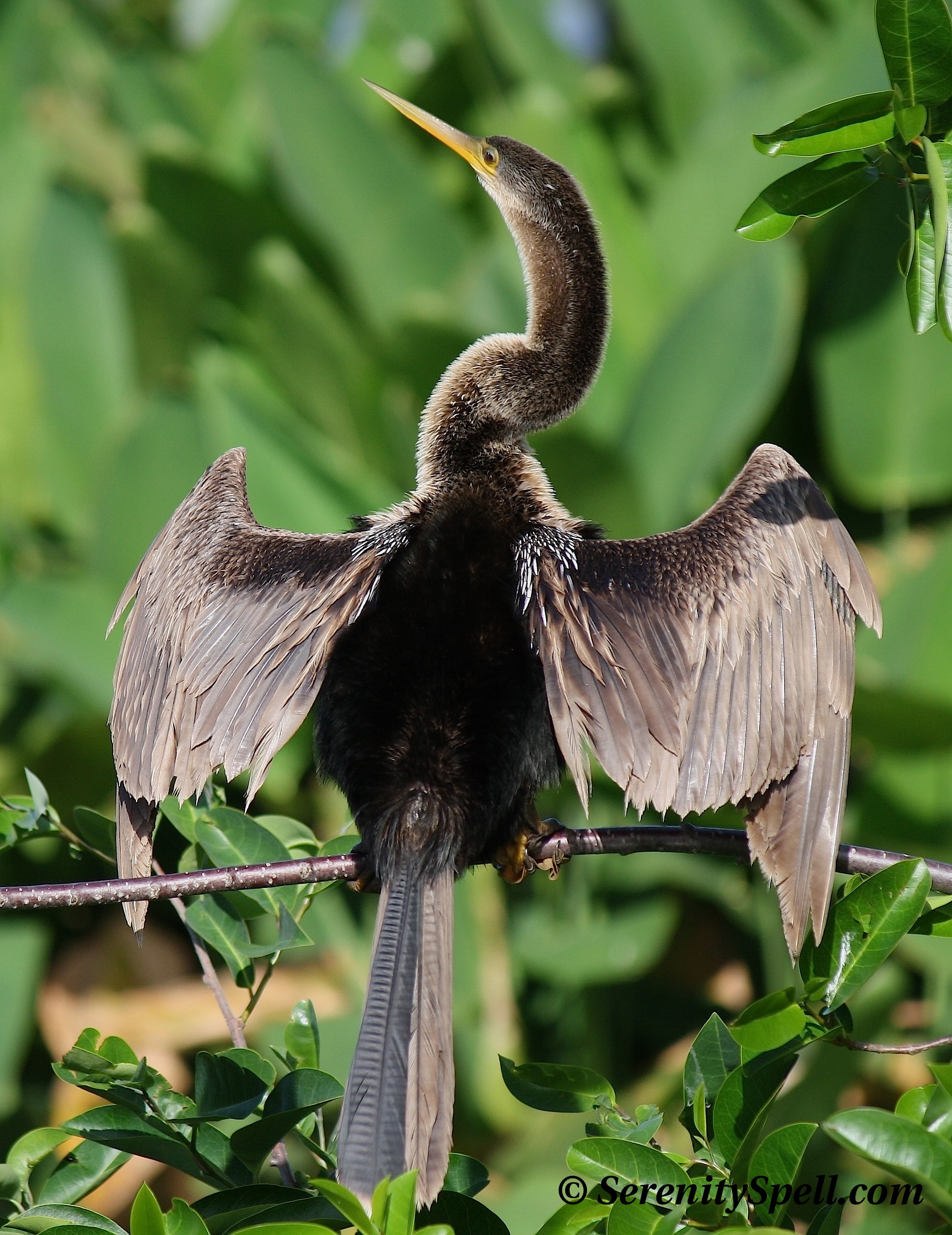
Anhinga Dries Its Wings
A noticeably calm cormorant — or “shag” (referring to the bird’s crest, which is lacking in the British forms of the Great Cormorant) — was preparing for a nap at the end of the boardwalk. These medium-to-large coastal (rather than oceanic) seabirds are plentiful in southeastern Florida, and can often be seen diving for fish or water snakes. After fishing, the cormorants dry their wings ashore in the sun or in the trees (similar to the cormorant-like anhingas), as their feathers don’t possess the waterproofing oil of other seabirds.
Humans have long used trained cormorants to fish the waters of China, Japan, and Macedonia. Trained by fishermen, a snare is tied near the base of the bird’s throat, allowing the bird to swallow only small fish. When the bird captures and tries to swallow larger fish, the snare doesn’t allow the fish to be swallowed, and it becomes stuck in the bird’s throat. The cormorant is forced to return to the fisherman’s boat, where he helps the bird regurgitate the fish, removing it from its throat. Traditional cormorant fishing isn’t as common a method today — with the development of more efficient fishing methods — but it remains a tourist draw. However, the method is still practiced in some Japanese regions, and has continued uninterrupted for 1300 years in Gifu City, in Gifu Prefecture.
Although both cormorants and anhingas are quite common in our area, I was struck by the serenity of this guy, and his beautiful teal eyes…. Their distinctive turquoise eyes fade quickly after the breeding / nesting season.
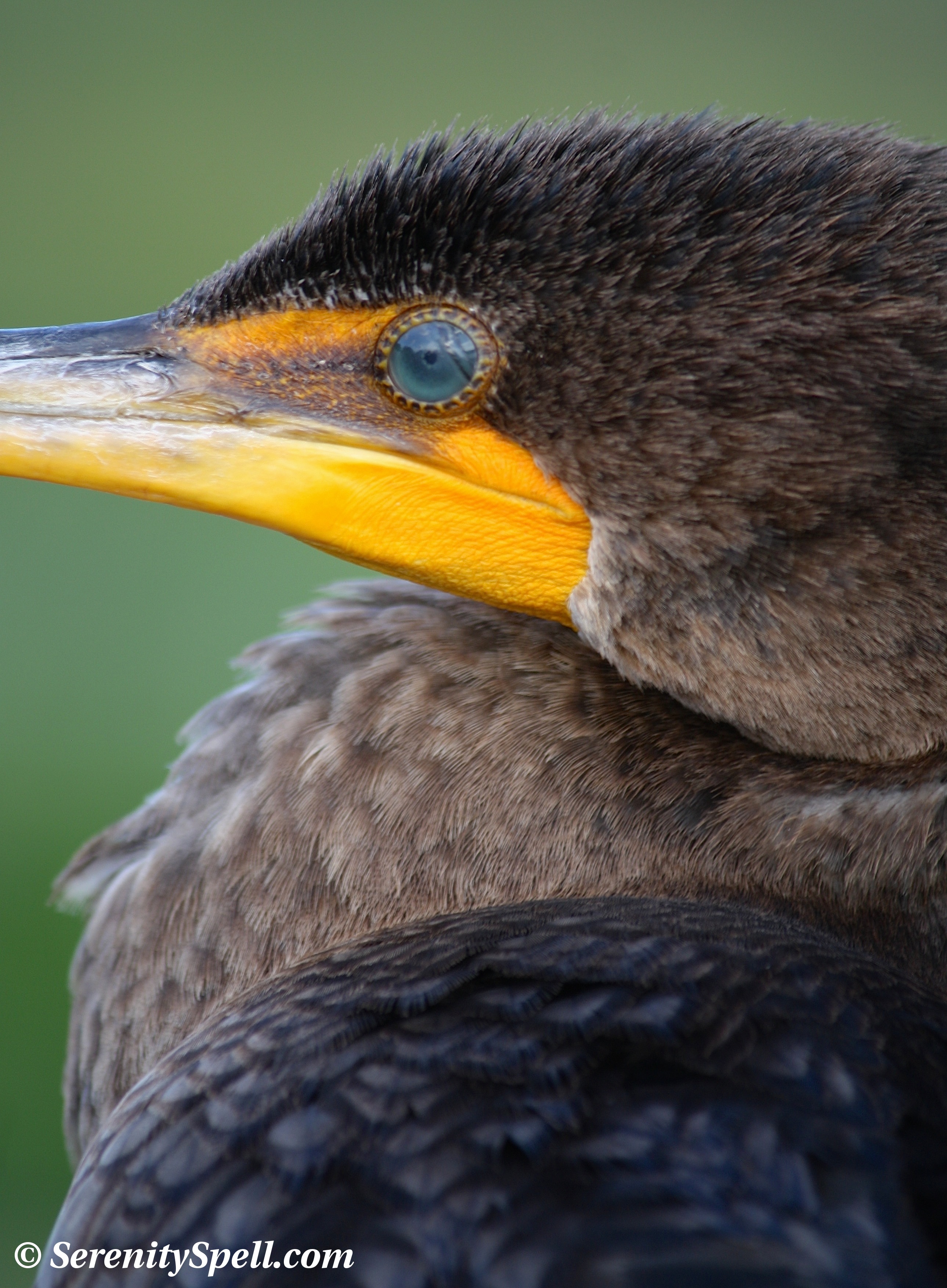
Lovely Teal Eyes of the Cormorant (Florida Wetlands)

Sharp Beak of the Cormorant (Florida Wetlands)

Dozing Cormorant in the Florida Wetlands

 FeyGirl
 Serenity Spell
Wonderful photography of this bird. Very interesting how humans use them to fish. I never knew that thank you for sharing.
Thanks!! There are some AMAZING images of traditional cormorant fishing, from deep in the more rural areas. These guys are sweet; but one never wants to get *too* near that bill of theirs… 🙂
loooooveee your photography 🙂 always makes me smile. Thank you!
Thanks so much!! Exploring, hiking, and photographing keeps me sane… Well, as sane as possible. 🙂
I hear you on that haha. Whatever works right? 🙂
i swear i’m going out on this may day with my camera, rain drops and all… 🙂
You have wonderful color and clarity in your photography! I also have been fascinated with the eyes of birds. The first time I saw a mature brown pelican I was startled by how human-like the blue eye seemed. As I continued to take more bird pictures I found it interesting how when the eye color is in the human range, the bird seems to have expression or seem friendly and when out of human color range more remote and alien. The turkey vulture for all its fierce appearance has friendly warm brown eyes. Yellow eyes seem cold and expressionless albeit fierce. The teal eye of the cormorant is beautiful for color and shape. I love the clarity of your shot and the reflected sky you can see on the top in the one labeled ‘sharp beak…’ Great close ups!!
Aw, thanks so very much!! I was lucky to get as close as I did with this fellow. You’re absolutely right, about birds’ eyes…. People are always drawn to other critters’ eyes, but not always to the birds and reptiles. But they’re just gorgeous; this picture doesn’t even capture the vibrant teal that I was witnessing. I’ve seen close-ups of turkey vultures, and I agree with you — they’re very kind eyes.
You are the only person that I know besides me that would use the word ‘kind’ to describe the eyes of a turkey vulture!! LOL It’s tru too!
Hahhh! But it’s so true… They haven’t been so kind, chasing us on hikes when they think we’re stealing their carcasses — but they’re so incredibly integral to the natural order. Perhaps that’s where the word comes from when I look at such shots. 🙂
Great photos – love the close ups! Happy May Day!
Thanks so much!! I was really lucky to get as close as I did to this very mellow guy. 😉 Happy May Day to you, too!
These are beautiful images. 🙂
Thanks so very much! I’m still hankering for that macro, though…. Heheheheh! 🙂
What beautiful photography. We have cormorants and anhingas in Louisiana, and I love watching them dry their wings – so funny. ❤
Thanks so much! Ah yes, I bet you have lots in LA! I love it when they hook their wings in the trees…. Newcomers to the area gawk and worry for them. It really is strange for seabirds not to have waterproofing, but it provides for some lovely scenes. 🙂
I envy all of your bautiful birds ! But i´m glad that you share your photos so i can look at them in your blog 🙂 . Both birds and photos are great ! // Maria
You’re so kind – thank you very much for your kind words! Our critters ARE very different, in our respective areas… But I have to say, I really want to visit your country to see your beautiful land and its inhabitants, too!
But in the meantime, I’ll keep sharing our guys. 🙂
As i said before, when ever you visit Sweden, you are most welcome to visit me . // 🙂 Maria
Oh MOST definitely!! That would be such a special treat… 🙂