Skip to content

Posts from the ‘Florida Birds’ Category

Pretty in Purple

Purple Gallinules are one of the shyer creatures of our wetlands, and to spy one is a fun and colorful event. Even if you’re a sly watcher and/or photographer, they’ll quickly flit into the dense marsh vegetation when they sense your presence…. It’s ironic, being as shy as they are, with such bold coloring. But it’s always a joy to spy these purple, blue, and green gems — especially so for me, as they’re all my favorite colors, wrapped up into one bright little bird.

These lovely creatures live in the freshwater marshes of the southeastern United States, as well as in Central America and the Caribbean — although they have turned up in the northern states and southern Canada, and even in parts of Europe and South Africa. There’s no mistaking this medium-sized rail, with its purple-blue plumage, green back, pale blue forehead, white undertail (of which I’ve caught more than one glimpse), bright red and yellow bill, and long yellow feet. The juveniles sport blander, brown colorations. The  gallinules’ huge legs make them awkward fliers, so short bursts of activity are their mode of transportation — or swimming like a duck if they’re not navigating the marsh with those dangling legs. They nest in floating constructs in the mashes (although I haven’t spotted many — they’re quite well hidden), laying 5-10 eggs.

The Purple Gallinule is omnivorous, eating the seeds, leaves, fruits, and grains of both aquatic and terrestrial plants; they also enjoy insects, frogs, snails, spiders, earthworms, fish, and even the eggs and young of other birds. When I see them in our wetlands, they’re often alone, nestled in the vegetation and cackling away — or being chased by other birds, most often by their sister species the Common Moorhen.

Purple Gallinule

Purple Gallinule — Nice Legs

Purple Gallinule

Purple Gallinule — White Undertail on Display

Purple Gallinule about to be chased into dense marsh vegetation by a defensive moorhen parent

Purple Gallinule successfully chased into dense marsh vegetation by a defensive moorhen parent

A Lady Grackle in a Pond-Apple Tree

Despite the commonality of these birds, I love to watch them. Well, I love to watch anything and everything when I’m out & about in nature, honestly — they’re all bright gems to me. I recently watched and photographed a Harvest Mouse for a good 15 minutes….

The Common Grackle (Quiscalus quiscula) is a large blackbird that’s often confused with the American Crow. Adult males are iridescent black, with long dark bills, long tails, and pale yellowish eyes. Females are slightly smaller and less glossy — brownish, in fact. Their song is a bit harsh, especially when it’s calm in our protected wetlands and several birds suddenly appear. They’re found across North America east of the Rocky Mountains, being permanent residents in much of this area. As forests were cleared for farmland, their range expanded west. Grackles nest in colonies, hiding their nests in dense trees and shrubs, often near water. These birds forage on the ground, in shallow water, or in shrubs — I’ve seen some interesting scenes of them skimming our wetlands’ duckweed in rapid flight for long periods of time…and I recently caught some photos of such an event. They’re omnivorous, and will steal food from other birds.

Pond-apple Tree Blossoms in the Florida Everglades

Young Pond Apple in the Florida Everglades

I caught this girl resting in a pond-apple tree, a common fixture in our wetlands, marshes, and the Everglades; they’re also known as Alligator-apple (for the fact that alligators will eat the fruit), Swamp-apple, Corkwood, Bobwood, and Monkey-apple. Unable to grow in dry soil and tolerant of saltwater, pond-apples are native to Florida, as well as the Caribbean, Central and South America, and West Africa. The tree averages 30-35 feet in height, and its blossoms are lovely creamy white and pale yellow, almost tulip-shaped. The fruit is apple-sized and mango-shaped, and falls when it’s green or ripening yellow. Edible to humans (it can be made into jam), the fruit serves as food for many species. It can be a bit bitter or tasteless for us, however (although its flesh is quite fragrant) — as my guy can attest to when I demanded he try it (“let’s make jam out of it!”). Pond-apple trees have become a scourge overseas, but in the Everglades they’re a valuable source of sustenance for our wildlife — I’ve seen alligator, raccoon, and all species of turtles munching on fallen pond apples. The trees provide shelter for myriad creatures, and their canopies are used as nesting grounds for all species of birds. Even more interesting, recent studies have shown that its alcoholic seed extract may provide anticancer compounds that could be used pharmaceutically.

Common Grackle in a Pond-apple Tree, Florida Wetlands

Common Grackle in a Pond-apple Tree, Florida Wetlands

Common Grackle in a Pond-apple Tree, Florida Wetlands

Pond-apple Tree: Note the thin trunks growing in clumps

A Calm Cormorant

At our protected Green Cay and Wakodahatchee Wetlands, where nesting and baby season remains in full swing (granted, the babies are growing, but there are some late-arrival nesters), some of the year-round residents don’t seem overly concerned with the consequent increase in human traffic. With more than 140 species of birds identified at Wakodahatchee, and the fact that it’s part of the Great Florida Birding Trail, the site is a birdwatcher’s and photographer’s paradise — especially now. I like to stroll towards the back of the boardwalk to admire some of the shyer inhabitants — and consequently avoid the chaos of the human visitors during this time of the year, when the wetlands’ newest residents are on display.

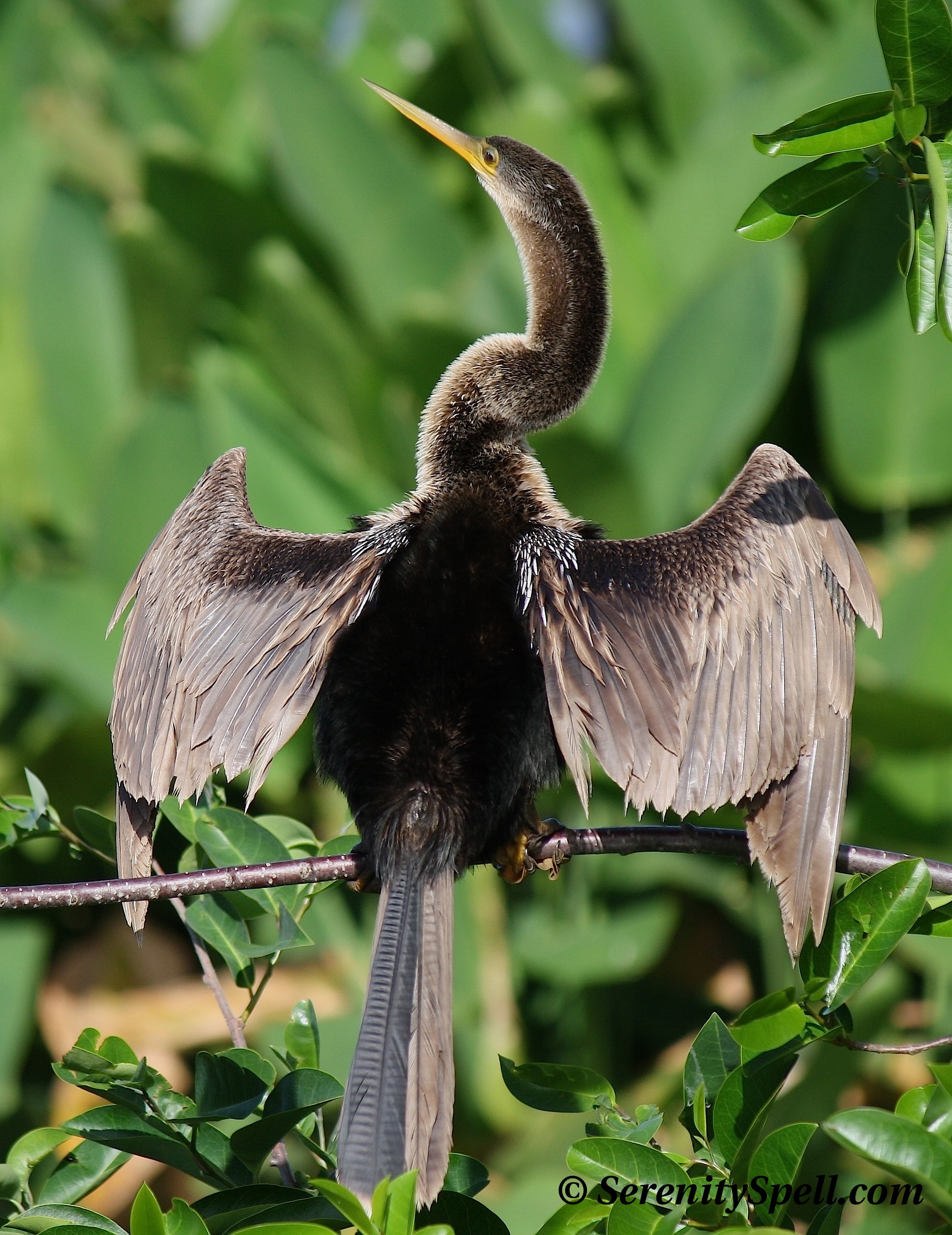
Anhinga Dries Its Wings

A noticeably calm cormorant — or “shag” (referring to the bird’s crest, which is lacking in the British forms of the Great Cormorant) — was preparing for a nap at the end of the boardwalk. These medium-to-large coastal (rather than oceanic) seabirds are plentiful in southeastern Florida, and can often be seen diving for fish or water snakes. After fishing, the cormorants dry their wings ashore in the sun or in the trees (similar to the cormorant-like anhingas), as their feathers don’t possess the waterproofing oil of other seabirds.

Humans have long used trained cormorants to fish the waters of China, Japan, and Macedonia. Trained by fishermen, a snare is tied near the base of the bird’s throat, allowing the bird to swallow only small fish. When the bird captures and tries to swallow larger fish, the snare doesn’t allow the fish to be swallowed, and it becomes stuck in the bird’s throat. The cormorant is forced to return to the fisherman’s boat, where he helps the bird regurgitate the fish, removing it from its throat. Traditional cormorant fishing isn’t as common a method today — with the development of more efficient fishing methods — but it remains a tourist draw. However, the method is still practiced in some Japanese regions, and has continued uninterrupted for 1300 years in Gifu City, in Gifu Prefecture.

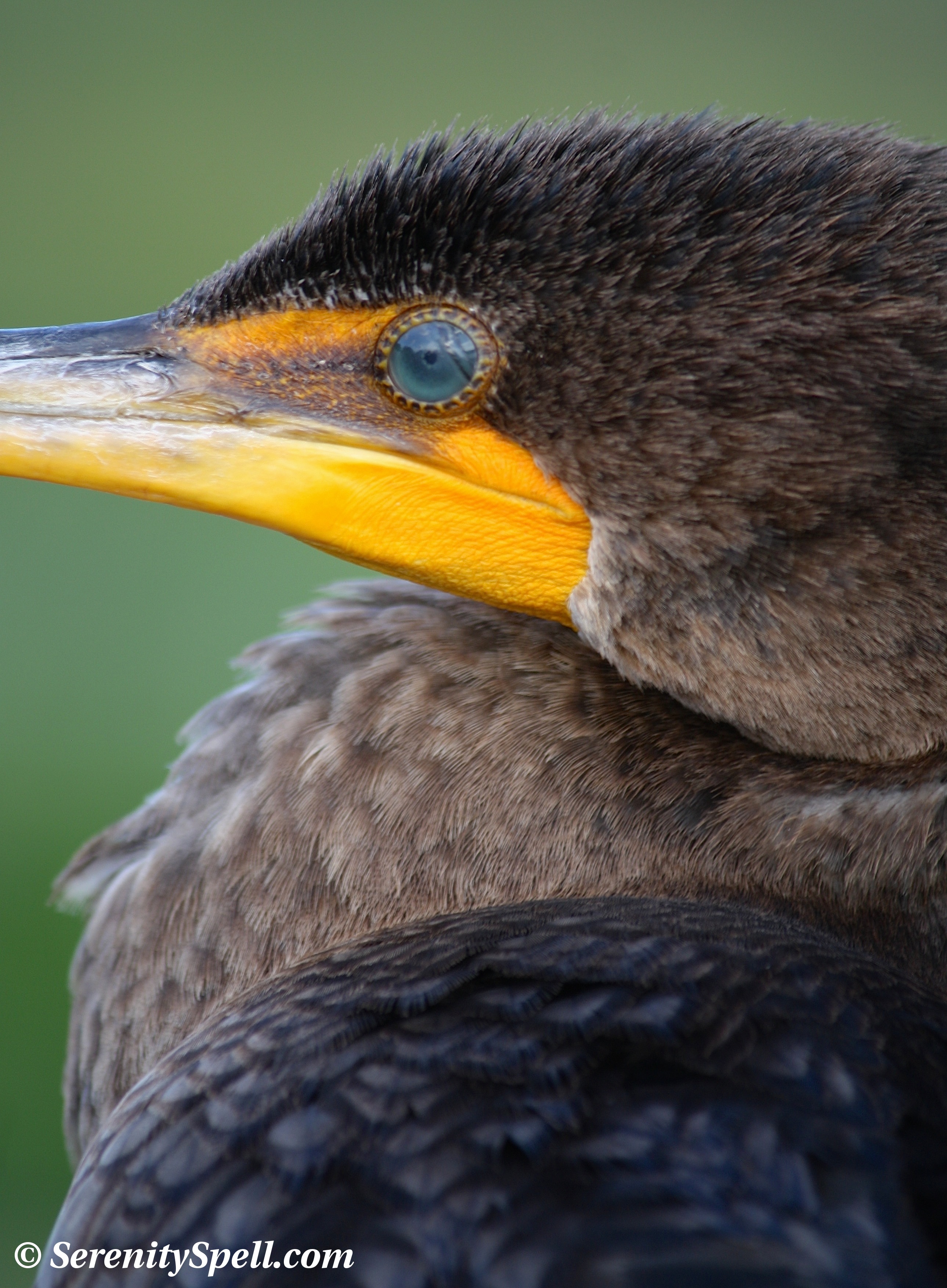
Although both cormorants and anhingas are quite common in our area, I was struck by the serenity of this guy, and his beautiful teal eyes…. Their distinctive turquoise eyes fade quickly after the breeding / nesting season.

Lovely Teal Eyes of the Cormorant (Florida Wetlands)

Sharp Beak of the Cormorant (Florida Wetlands)

Dozing Cormorant in the Florida Wetlands

The Greening of the Great Egret

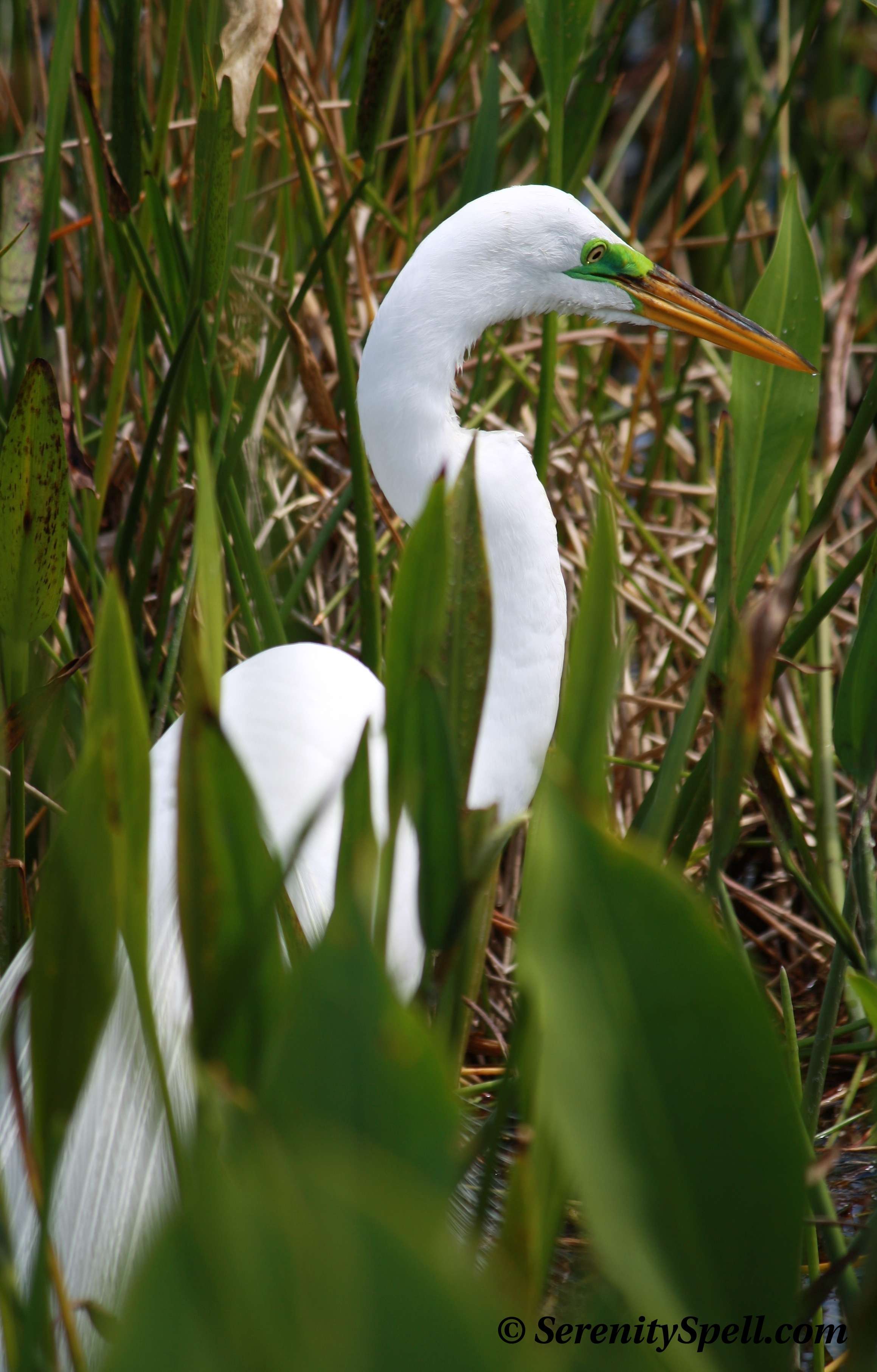
As mentioned in my previous post, I had to save an image of one Great Egret for its own space. At the beginning of this year’s breeding season I was able to catch a lovely model, sporting a shocking green lore — the area between the bill and the eyes. During the breeding season, the lore may turn a vibrant green; the Great Egret will also display long, elegant plumes on its back (evident in the second picture, slightly blocked by the swamp vegetation), which are used in courtship displays. Like a peacock, the feathery plumes will spread out like a fan. Outside the breeding season, these long feathers disappear.

Great Egrets are striking to spy in the swamp — their ethereal beauty, graceful stalking, and quiet strength is captivating. But the brilliant green lore and feathery plumes add yet more stunning display to an already magical scene.

Great Egret with Green Lore in the Florida Wetlands (Close-Up)

Great Egret with Green Lore in the Florida Wetlands


The Great Egret

It’s hard not to be captivated by this bird; they’re the epitome of ethereal beauty, grace and strength, stalking and flying through our swamps and wetlands.

Great Egrets, also known as the Great White Egret, the American Egret, the Large Egret or Common Egret, are a common sight in our wild spaces — even our neighborhoods. They’re the largest egret in the Old World — thus the GREAT of their title. In the New World however, Great Blue Herons win the size competition. Great Egrets are large egrets boasting brilliant all-white plumage, and are found across much of the world, from southern Canada to Argentina, and in Europe, Africa, Asia, and Australia. Standing approximately 3 feet tall, great egrets have graceful necks, long black legs, and black feet. Their bills are straight, pointed, and yellow.

These egrets feed by stalking, wading in the shallow water, patiently waiting for fish — then grabbing or stabbing their hapless meal with sharp bills. I’ve also seen them dine on amphibians, reptiles, and small mammals.

Great Egret Stalking and Catching Fish… Got It!

They fly with their necks pulled back in an S-curve, like so:

Great Egret in Flight

Great Egret in Flight at the Protected Wetlands, Dusk

The Great Egrets in our wetlands nest in colonies with other egrets and herons. The nest is constructed of sticks and covered with vegetation, and located in trees or shrubs — or on tree-island rookeries. Not all egret hatchlings survive the nestling period — aggression is common, with the larger chicks often killing the smaller or weaker siblings. The oldest known wild Great Egret lived nearly 23 years.

The feathers of the Great Egret are stunning, almost unreal; sadly, these beautiful birds were hunted mercilessly — nearly to the point of extinction, their numbers decimated by 95 percent — towards the end of the 19th century. Their breeding plumage was especially prized, and their treasured feathers were used in hats across the globe. With conservation measures enacted, their numbers grew throughout the 20th century. While wetland habitat loss is once again threatening their existence, these birds have a high adaptability to human habitation. Of course, the loss of wetland ecosystems remains another issue altogether….

Great Egret Coming in for a Landing

In 1953 the Great Egret was chosen as the symbol of the National Audubon Society, the environmental organization formed to protect birds.

Logo — The Great Egret in Flight (Courtesy of The National Audubon Society)

During the breeding season, the Great Egret displays long, elegant plumes on its back, which are used in courtship displays. Like a peacock, the feathery plumes spread out like a fan. (Outside the breeding season, these long feathers disappear.) During this time, the lore (the area between the bill and the eyes) may turn vibrant green. Nature’s colors are brilliant, and this picture deserves its own (upcoming) post….

Great Egret Takes a Break While Stalking His Meal