Skip to content

Posts tagged ‘birds’

Paying It Forward: A Giveaway Contest!

I doubt these juvenile cattle egrets are actually enjoying each other’s presence — they’re most likely fighting for nest dominance — but for our purposes, it’s gifting-time!

Arguing Juvenile Cattle Egrets in the Florida Wetlands

I thought this was a wonderful idea, forwarded by Long Life Cats and Dogs — who in turn was shared it by another blogger. THANKS! So I’m now paying it forward with a giveaway-contest. I LOVE the idea of giving back to such a generous, kind, and talented group of people. Besides, making, giving, and receiving = FUN!

The first three people to comment on this post will receive a gift, a little homemade something, with our Everglades at heart (of course, no critters were harmed in the making of said gift).

The fine print:

  • Within a year, I’ll create something unique to share with the first three people to comment on this post. (I promise it won’t take me an entire year!)
  • In order to receive your gift, you must play along. Spread the love on your own blog, promising to send a little special something to the first three people who comment on your post. Pay it forward!
  • You get 72 hours to re-post, or I’ll move on to the next person. Sorry, apparently there are RULES.

So if you’d like a little something from our Everglades, comment below! And please — if you’re not willing to pay it forward, or if you don’t want something nature-based, created by an Earth-loving-slightly-hippy-hiker, I would hesitate…. ♥

Watching the Divine

Stranger

by Thomas Merton

When no one listens
To the quiet trees
When no one notices
The sun in the pool.

Where no one feels
The first drop of rain
Or sees the last star

Or hails the first morning
Of a giant world
Where peace begins
And rages end:

One bird sits still
Watching the work of God:
One turning leaf,
Two falling blossoms,
Ten circles upon the pond….

(For complete poem, click here)

Deep in a swamp of the northern section of our Everglades, we spied this solitary Great Blue Heron relaxing on a fallen log. Far in the SWA Trails of the Grassy Waters Preserve — along the outer Owahee Trail — there was little to disturb her. She remained there on our return trip, hours later — at complete peace in the beautiful remnants of this most amazing and completely unique ecosystem.

Here’s to hoping that Mother Nature is gentle on Florida, and that Isaac gives us nothing more than nice winds and rains. A shift to the west would be extra kind, to provide Texas with some much-needed rain…. In the meantime, there are many brave and wonderful people working overtime in preparation for the upcoming storm — including 100+ Abandoned Dogs of Everglades Florida. This group rescues dogs, abandoned and left to fend for themselves in the harsh wilderness of the Everglades (along with cats and even horses). They provide these animals desperately needed medical attention (many are starving), and find foster and permanent homes for them. Much luck and love to these volunteers.

Green Heron Hunting

Do whatever you do intensely. —Robert Henri

I encountered this Green Heron — one of my favorites in our wetlands — perched high in the beautiful cypress trees, stalking its dinner during the approaching dusk. He sat with such intense focus (that face!), that I admired in silence for the entirety of his watch.

But this guy wasn’t just watching; he was most likely waiting. Green herons will often drop bait onto the water’s surface — including live insects, berries, twigs, or feathers — to attract fish. The more curious the fish…the more likely they’ll be dinner at the quick thrust of the heron’s sharp bill. This hunting technique, and use of tools, has earned Green Herons the well-deserved distinction as one of the world’s smartest birds.

When I hear their signature kuk or kyow, I search for these shy guys and their moppy crowns, in the hopes of catching them hunting. Click here to listen to their calls!

Green Heron hunting in the wetlands… FOCUS!

Green Heron eyes a meal in the wetlands… PATIENCE!

Why You Sweet, Black-bellied…

Black-bellied Whistling Ducks — also known as Black-bellied Tree Ducks — are a common sight in our wetlands. I adore these ducks: They have a quirky appearance, they’re docile and sweetly tempered, and are constantly paired. You rarely see one without its companion.

The Black-bellied Whistling Duck is one of only two whistling-duck species native to North America, and is most often referred to as simply the “whistling duck” in our area — and in the South in general. These ducks are considered unusual for North American waterfowl, with their striking appearance, long, dangling legs, and odd feeding habits. The males and females of the species look alike.

Black-bellied Whistling Duck Looking over His Wetlands

Mainly non-migratory, Black-bellied Whistling Ducks are native to the southernmost United States and South America. They live in freshwater ponds, lakes, and marshes, or cultivated land and reservoirs that are plentiful with vegetation. They usually nest in hollow trees, but will nest on the ground when necessary. As cavity nesters, they make use of chimneys, abandoned buildings, or nest boxes. Nest boxes have been increasingly provided to these ducks over recent decades, thus helping rebuild their numbers.

Black-bellied Whistling Ducks Flying over the Wetlands

It’s common to see these whistling ducks feeding on vegetation as they wade through the shallow waters, but they’ll also consume arthropods and aquatic invertebrates. In other areas, they feed on recently-harvested fields for leftover seed and invertebrates turned up by farming equipment.

In years past, overhunting of this docile species was a great concern — however, over the past 30 years their populations have increased significantly (nest boxes having helped their cause). They’re sweet and colorful additions to our wetland ecosystem.

Black-bellied Whistling Duck Pair in the Wetlands

Fun Fact:

The Black-bellied Whistling Duck is unique among ducks — they’re more like geese and swans, in that they form strong monogamous bonds. Pairs will often remain together for many years. And they’re progressive! Both the male and female share the tasks of raising the young, from incubation to rearing.

Stalking at Dusk

The possession of knowledge does not kill the sense of wonder and mystery. There is always more mystery. —Anais Nin

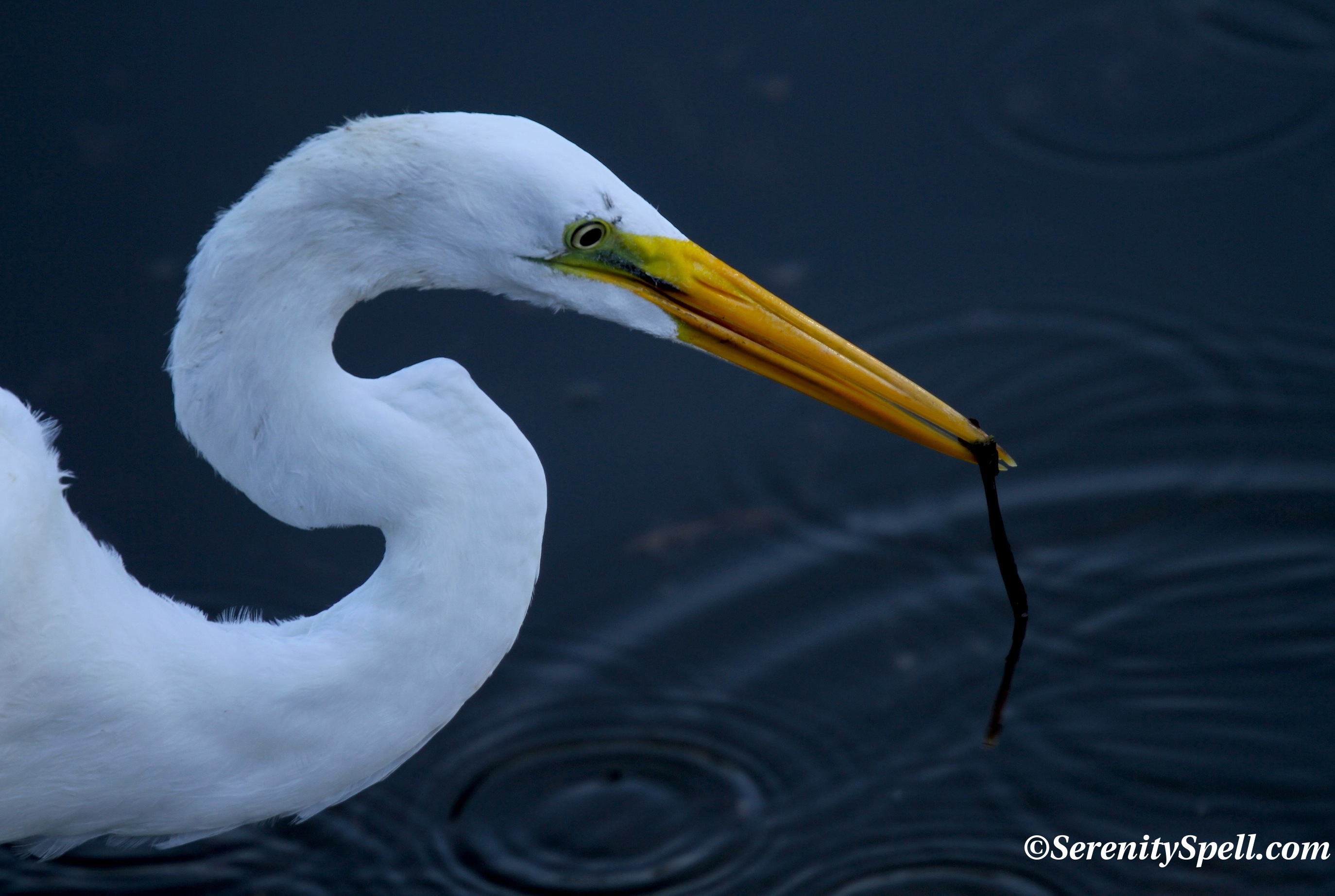
One of the birds I most enjoying watching in our wetlands and swamps is the Great Egret.  It’s hard not to be captivated by these creatures — the epitome of ethereal beauty, grace and strength, they wade, stalk and fly in our waters with balletic poise. They’re the largest egret in the Old World — thus the great of their title. In the New World however, Great Blue Herons win the size competition. I recently watched one lovely Great Egret hunting at dusk in our nearby Everglades preserve.

Great Egret Hunting in the Florida Everglades

Boasting brilliant all-white plumage, the feathers of the Great Egret are stunning, almost unreal; sadly, these beautiful birds were hunted mercilessly towards the end of the 19th century — nearly to the point of extinction, their numbers decimated by 95 percent. Their breeding plumage was especially prized, and their treasured feathers were used in hats across the globe. During the breeding season, the Great Egret displays long, elegant plumes on its back, which are used in courtship displays. During this time, the lore (the area between the bill and the eyes) also turns a vibrant green (see The Greening of The Great Egret).

Great Egret Wading in the Florida Everglades

But with conservation measures enacted, their numbers grew throughout the 20th century. While wetland habitat loss is once again threatening their existence, these birds have a high adaptability to human habitation. Of course, the loss of wetland ecosystems remains another issue altogether for other wildlife and flora….

In 1953 the Great Egret was chosen as the symbol of the National Audubon Society, the environmental organization formed to protect birds.

National Audubon Society Logo — The Great Egret in Flight (Courtesy of The National Audubon Society)