Skip to content

Posts tagged ‘nature’

Why You Sweet, Black-bellied…

Black-bellied Whistling Ducks — also known as Black-bellied Tree Ducks — are a common sight in our wetlands. I adore these ducks: They have a quirky appearance, they’re docile and sweetly tempered, and are constantly paired. You rarely see one without its companion.

The Black-bellied Whistling Duck is one of only two whistling-duck species native to North America, and is most often referred to as simply the “whistling duck” in our area — and in the South in general. These ducks are considered unusual for North American waterfowl, with their striking appearance, long, dangling legs, and odd feeding habits. The males and females of the species look alike.

Black-bellied Whistling Duck Looking over His Wetlands

Mainly non-migratory, Black-bellied Whistling Ducks are native to the southernmost United States and South America. They live in freshwater ponds, lakes, and marshes, or cultivated land and reservoirs that are plentiful with vegetation. They usually nest in hollow trees, but will nest on the ground when necessary. As cavity nesters, they make use of chimneys, abandoned buildings, or nest boxes. Nest boxes have been increasingly provided to these ducks over recent decades, thus helping rebuild their numbers.

Black-bellied Whistling Ducks Flying over the Wetlands

It’s common to see these whistling ducks feeding on vegetation as they wade through the shallow waters, but they’ll also consume arthropods and aquatic invertebrates. In other areas, they feed on recently-harvested fields for leftover seed and invertebrates turned up by farming equipment.

In years past, overhunting of this docile species was a great concern — however, over the past 30 years their populations have increased significantly (nest boxes having helped their cause). They’re sweet and colorful additions to our wetland ecosystem.

Black-bellied Whistling Duck Pair in the Wetlands

Fun Fact:

The Black-bellied Whistling Duck is unique among ducks — they’re more like geese and swans, in that they form strong monogamous bonds. Pairs will often remain together for many years. And they’re progressive! Both the male and female share the tasks of raising the young, from incubation to rearing.
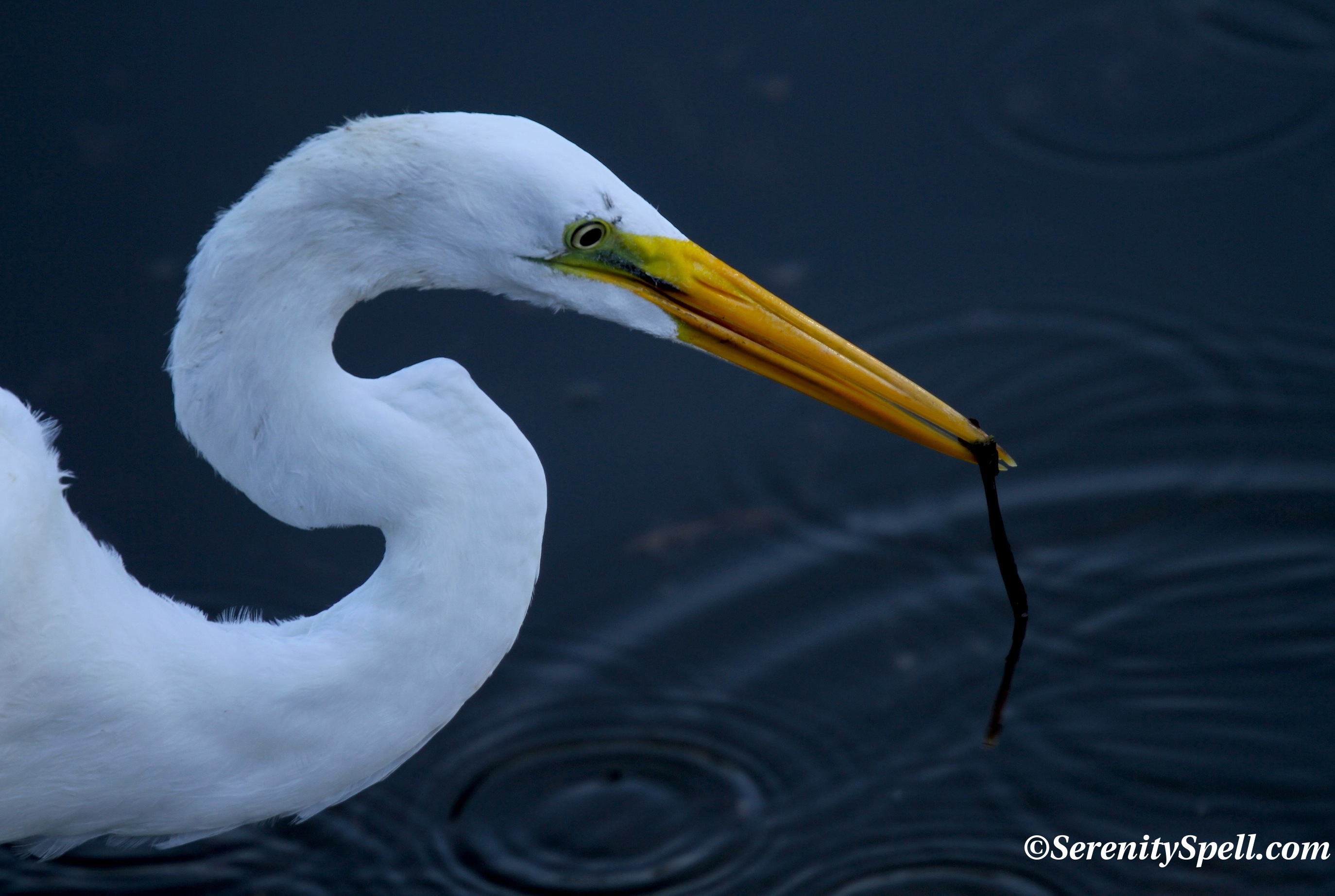
Stalking at Dusk

The possession of knowledge does not kill the sense of wonder and mystery. There is always more mystery. —Anais Nin

One of the birds I most enjoying watching in our wetlands and swamps is the Great Egret.  It’s hard not to be captivated by these creatures — the epitome of ethereal beauty, grace and strength, they wade, stalk and fly in our waters with balletic poise. They’re the largest egret in the Old World — thus the great of their title. In the New World however, Great Blue Herons win the size competition. I recently watched one lovely Great Egret hunting at dusk in our nearby Everglades preserve.

Great Egret Hunting in the Florida Everglades

Boasting brilliant all-white plumage, the feathers of the Great Egret are stunning, almost unreal; sadly, these beautiful birds were hunted mercilessly towards the end of the 19th century — nearly to the point of extinction, their numbers decimated by 95 percent. Their breeding plumage was especially prized, and their treasured feathers were used in hats across the globe. During the breeding season, the Great Egret displays long, elegant plumes on its back, which are used in courtship displays. During this time, the lore (the area between the bill and the eyes) also turns a vibrant green (see The Greening of The Great Egret).

Great Egret Wading in the Florida Everglades

But with conservation measures enacted, their numbers grew throughout the 20th century. While wetland habitat loss is once again threatening their existence, these birds have a high adaptability to human habitation. Of course, the loss of wetland ecosystems remains another issue altogether for other wildlife and flora….

In 1953 the Great Egret was chosen as the symbol of the National Audubon Society, the environmental organization formed to protect birds.

National Audubon Society Logo — The Great Egret in Flight (Courtesy of The National Audubon Society)

A Rainy Walk, a Cache of Found Feathers, and a Jealous Gator

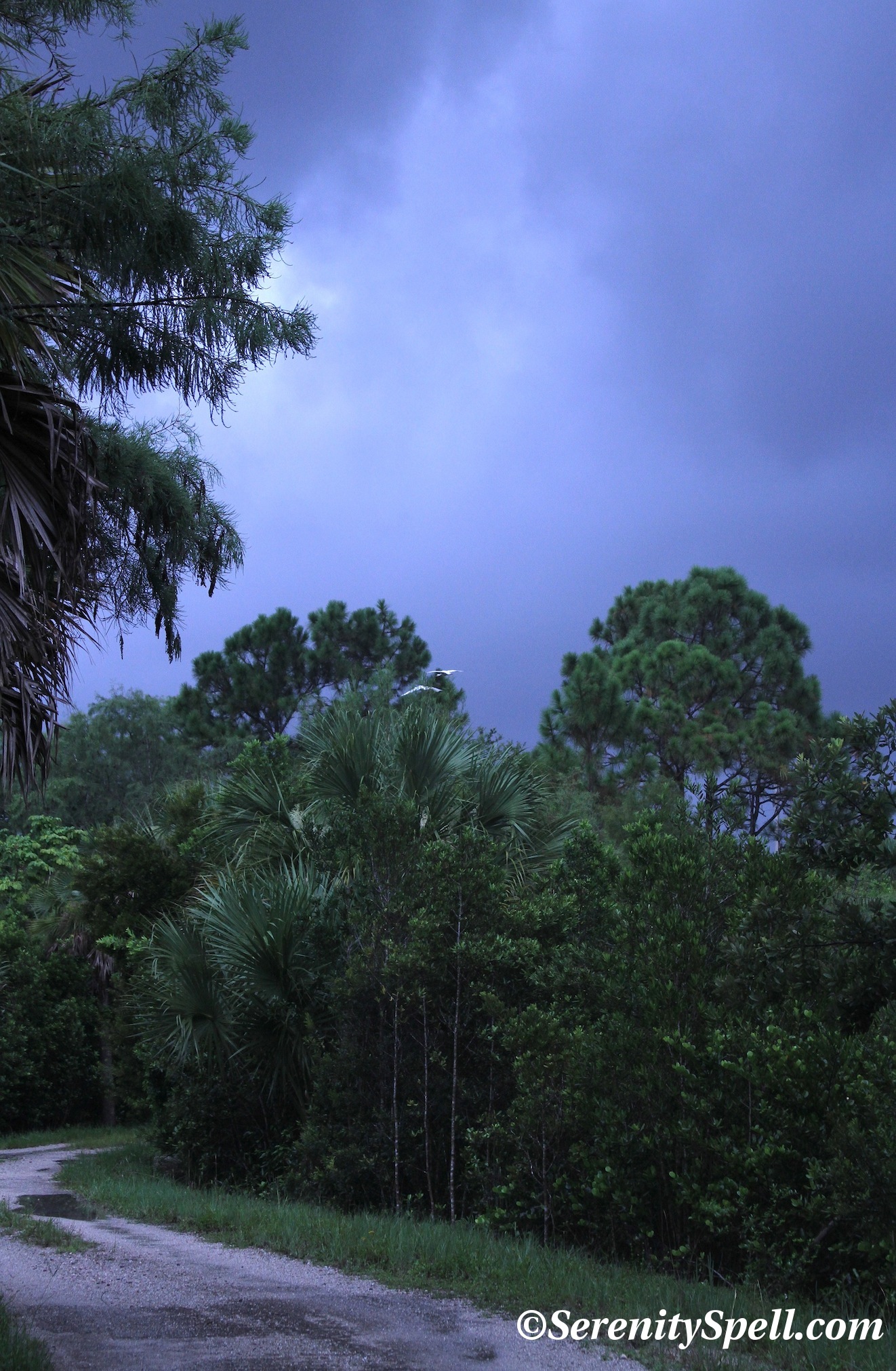
On an especially soggy day — we underestimated the might of the day’s thunderstorms — we pushed ahead with our continued exploration of West Palm Beach’s Grassy Waters Preserve. We hadn’t explored the SWA Trails within the Preserve, and had been searching to see how they linked to the outer Owahee Trail. While we couldn’t do much on this particular day — the rains and lightning proved too much, even for us — we were able to stretch our legs a bit, and visit with hundreds of egrets, herons, and ibis.

And even better? I collected feathers; oh, I collected feathers. If there’s anyone in blog-land who’s equally enamored with the loveliness and power of Everglades’ feathers, just holler. I have plenty that I’d be willing to share — and one can make only so many smudge sticks out of found feathers….

Heading into the SWA Trails: We should be good. Sure.

Further into the trails: Whoops. Looking a bit dark; where’s our ponchos?

Sabal Palm Tree along the trail

Graceful as ever, a Great Blue Heron flies down a waterway on the Rookery Loop

Flying Ibis against invasive Australian Pines

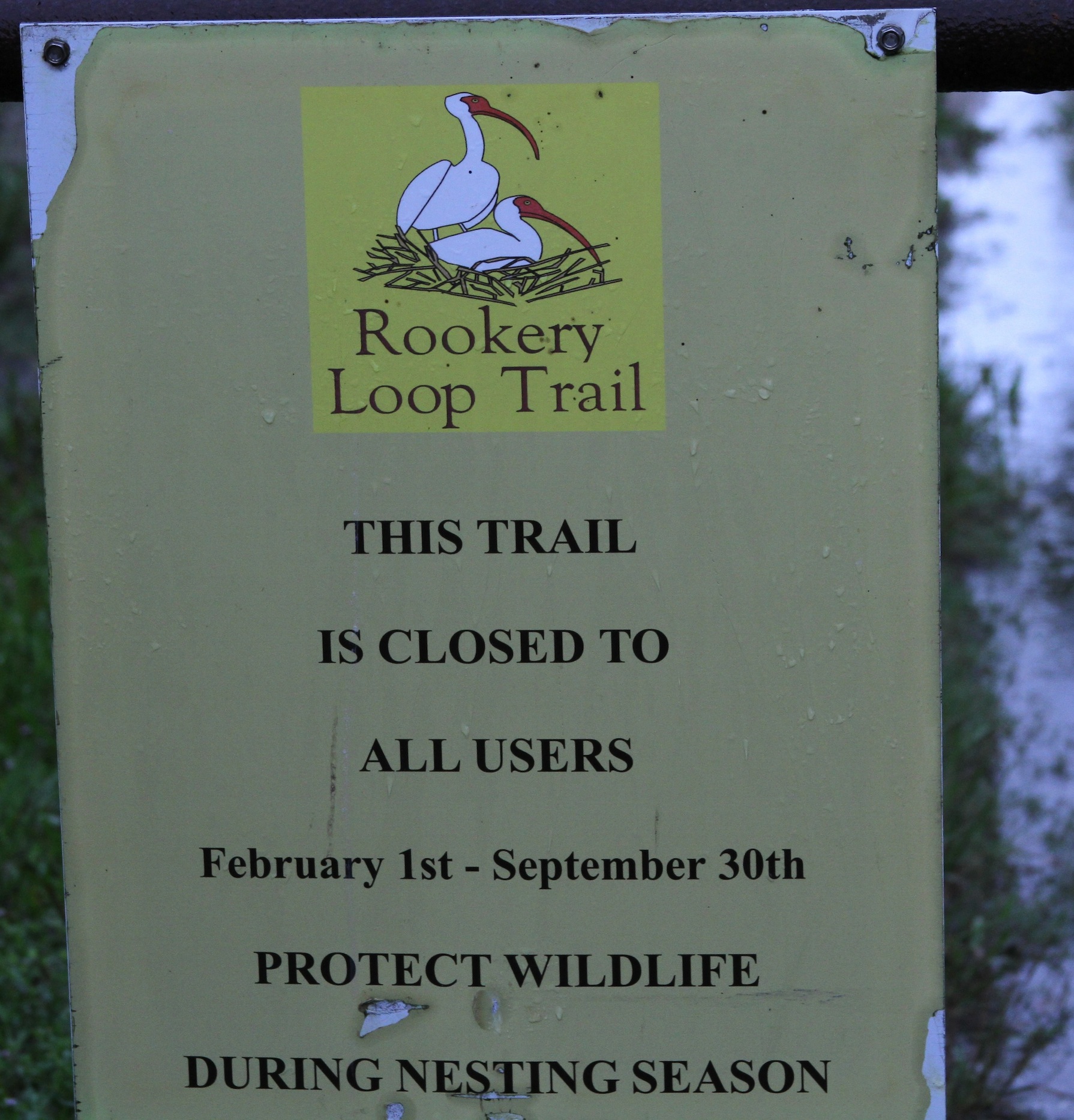
Rookery Loop Signage: CLOSED! Nooo…! But how wonderful they’re protected.

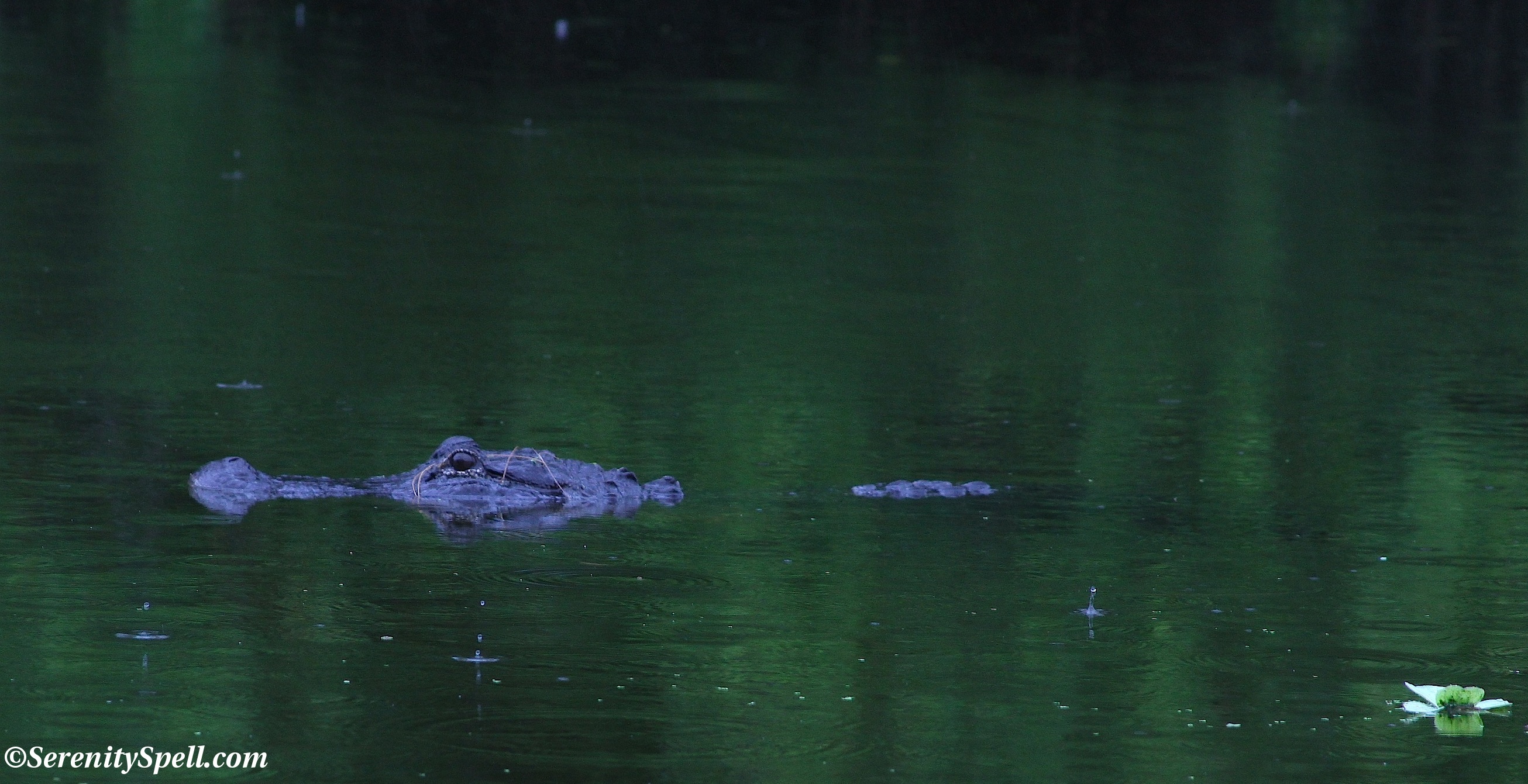
And, of course…. An alligator encounter! This guy was a juvenile, very small. But most amusing about him (her?) was that, as I was praising his loveliness and snapping shots, he swam ever closer. Unbeknownst to me, my guy had silently crept up to take a peek, and this little gator’s calm demeanor suddenly changed — he thrashed wildly in the water, like a bezerker on acid. We both jumped like jackrabbits, and the human male skulked away, muttering something about a “big dumb lizard”…. I think he was just jealous. And as if on cue, up popped the gator, swimming back towards me for another cooing session.

Alligator Near the Rookery Loop Trail: A Lovely Friend

Alligator Near the Rookery Loop: Come Closer, Cutie

Anoles of the Rainbow — and a Newly Discovered Color Variant!

There are myriad lizards in our Florida wilds — chirping geckos, monitors, prehistoric basilisks, stealthy iguanas, invasive curlytails, skinks, lined racerunners, and colorful anoles, just to name a few. But the anoles  stand out in  ever-lovely radiance. I’ve had the luck to spot not only green, but rare yellow-phased anoles — and now, a newly discovered (and as yet, unwritten) mutation — orange!

While I haven’t seen anything scientific written on this new color variant to date, a few others have noted their existence in South Florida in the last few months. At first, it was considered an oddity — or perhaps a side-effect of the high concentration of iron in the ground water. However, I captured this guy in the wilds of the northern section of the Everglades, not in an urban neighborhood with sprinkler systems. FASCINATING! The red/orange coloration of these anoles is curious and striking, and it will be interesting to read further input of their new color-phased mutation in the upcoming months.

An Orange Anole knows he’s special in the Grassy Waters Preserve

Orange Anole shows off his equally orange dewlap in the Grassy Waters Preserve

During a walk through Fern Forest, a magnificent 247-acre conservation site and wildlife refuge characterized as “the last remaining stronghold of ferns in southeastern Florida,” we spied a rare yellow anole (aka yellow-phased green anole). Unfortunately, anoles with this unique color mutation don’t usually live long in the wild, as the green coloring offers them valuable camouflage for hunting prey and hiding from predators. Colonies of these rare color-phased anoles have been reported — and I like to think this guy was part of one….

A Yellow-phased Green Anole in Fern Forest

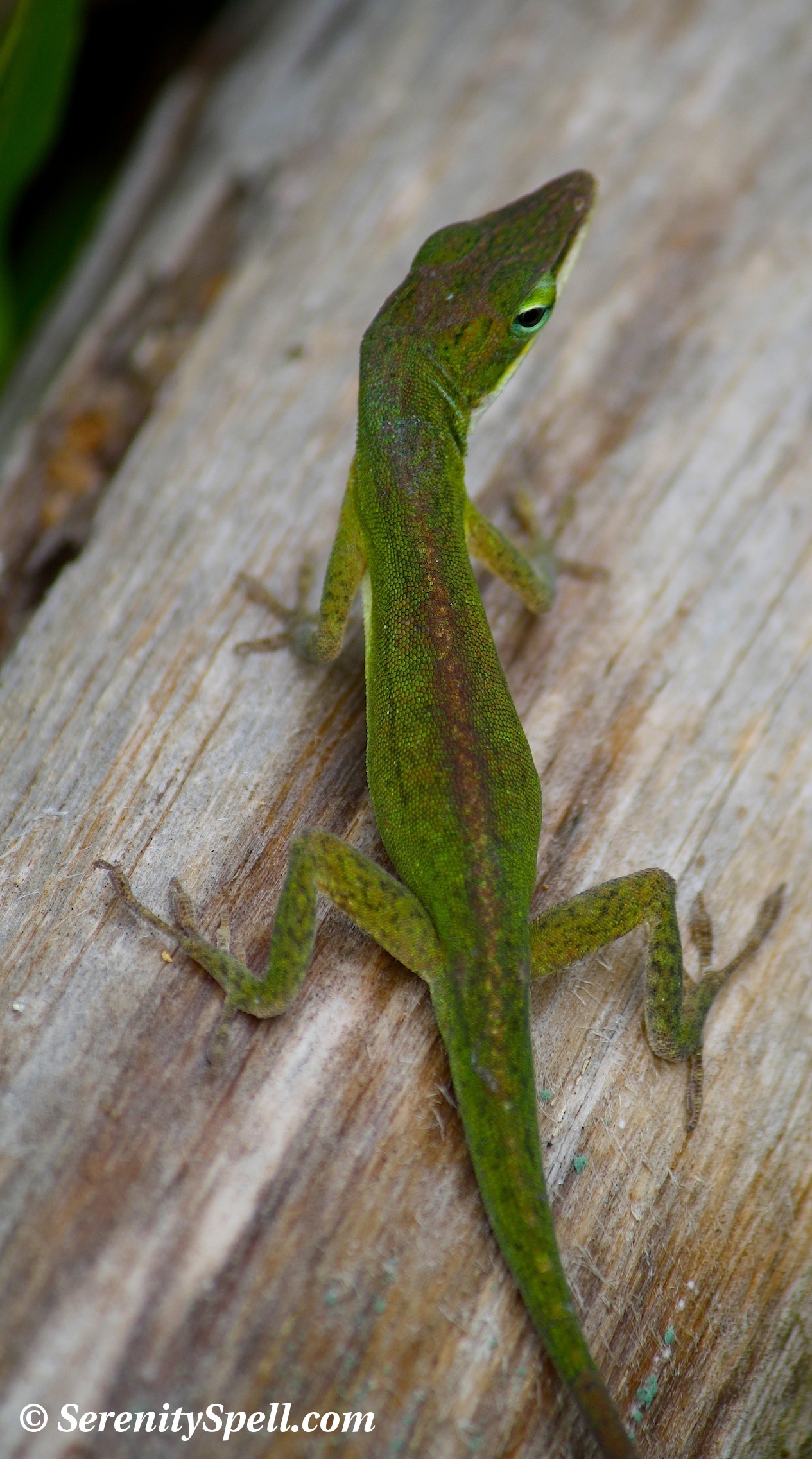
Far into our hike on the Hog Hammock Trail in the Grassy Waters Preserve — on a particularly hot and humid, but fortunately cloudy day — I spied a flash of green at the water’s edge. Luckily it was a *small* green flash. A green anole kindly took the time to pose for me and my camera.

A Green Anole poses along the Hog Hammock Trails in Grassy Waters

Brainy Bandits

Everyone knows raccoons — these little bandits are familiar to forests (their original habitats), marshes, prairies, neighborhoods, and even cities. In addition to the northern or North American raccoon, which is native to North America, there are six other species of raccoons, most of which live in the tropics.

A brave raccoon at the Barnacle Historic State Park in Miami, accustomed to the city folk…

Diet and Habitat

This highly adaptable and nocturnal mammal feasts on a variety of fare, but in their natural environment they mainly hunt near water. They use their paws and claws to grab frogs and other aquatic critters, while on land they eat mice, insects, and steal eggs. They also rely on fruit and plants, and of course…human leftovers! In the north, raccoons will gorge themselves in the spring and summer to store up body fat for the colder months ahead.

A raccoon’s most important sense is that of touch; most of the animal’s senses are in the tactile impulses of these “hyper sensitive” front paws.

…and the treats they leave behind! An opportunistic pasta feast for this raccoon family.

During the winter, they spend much time asleep in their dens — a tree hole, fallen log, or crawl/attic space. Raccoons rely on vertical structures to climb when they feel threatened, so it’s rare to see them in the open. In the early summer, females may have up to seven cubs, which spend their first two months in the den. However, it’s usual for only half of the young to survive a full first year. But if they survive, they begin exploring the world with their mother….

Behavior

While these animals were originally considered solitary creatures, there is increased evidence that raccoons engage in gender-specific social behavior. Related females will share a common area, while unrelated males live together in groups of up to four animals to protect against foreign males (and predators) during the mating season.

The increased presence of raccoons in populated areas has resulted in diverse reactions among humans — but the truth remains, serious attacks on humans or pets by non-rabid raccoons are extremely rare, and are almost always the result of the raccoon feeling threatened, or protecting its young.

Nom nom nom.

Mythology

The raccoon was a prominent figure in the mythology of the indigenous peoples of the Americas. The Tuscarora told stories of its skills at foraging; while in other tales, the raccoon was the trickster which outsmarted other animals — even coyotes and wolves. The Dakota Sioux believed the raccoon had spirit powers, since its mask resembled the black-and-white facial paintings used during their rituals to connect to spirit beings. The Aztecs linked the raccoon’s supernatural abilities especially to the females, whose commitment to their young was associated with the role of wise women in their society.

Petroglyphs depicting raccoons span across the continental United States: engraved raccoon tracks have been found in Lewis Canyon, Texas; at the Crow Hollow petroglyph site in Grayson County, Kentucky; and in river drainages near Tularosa, New Mexico and in San Francisco, California. A detailed quartz figurine — the Ohio Mound Builders’ Stone Pipe — was found near the Scioto River. The meaning of Raccoon Priests Gorget, featuring a stylized carving of a raccoon found at the Spiro Mounds in Oklahoma, remains unknown.

Fun Facts:

Raccoons are little smarties! Highly intelligent, studies from the ’60s to today show that they can remember the solutions to tasks — as well as differentiate between symbols — for up to three years. (Longer than me.) Raccoons have also been tested on opening complex locks with great success.

The word “raccoon” comes from the native Powhatan term. It was originally recorded in the Virginia Colony, on Captain John Smith’s list of Powhatan words as aroughcun, and in the records of William Strachey as arathkone. It also hails from the Proto-Algonquian root *ahrah-koon-em, meaning “[the] one who rubs, scrubs and scratches with its hands.”

Spanish colonists adopted the Spanish word mapache from the Aztecs — Nahuatl mapachitli, meaning “[the] one who takes everything in its hands.” In many languages, from German to Italian, the raccoon is named for its characteristic dousing behavior, in addition to that language’s term for bear.