Skip to content

Posts tagged ‘nature’

Fae Mouse; or a Visit with an Eastern Harvest Mouse

Despite the commonality of some critters, I love to watch them just as much as any other — they’re all captivating. I recently watched and photographed an Eastern Harvest Mouse for a solid 20 minutes….

This little guy is common in Florida’s wetland ecosystems, but other natural habitats include subtropical and tropical grasslands, scrub, swamps, prairies, meadows, and pastureland. Their range includes the Great Lakes, Mid-Atlantic, Southeast, Florida, and Texas. While the Eastern Harvest Mouse eats seeds, fresh plant matter, and small insects, they’re prey for our snakes, bobcats, large wading birds, and birds of prey. Their nests are constructed of shredded grasses and plant fibers, and are used by the mice year-round. Offspring are usually born in the late spring, summer, or early fall, with litter sizes ranging from 2 – 7.

I realize many people are spooked by rodents, mice in particular. Perhaps it’s my love of fairy tales, or plain fondness for all critters — every one — but I always see fairies accompanying them. Honestly, he’s adorable; as I’m always saying: THAT FACE!

Eastern Harvest Mouse, Florida Wetlands

Courtesy Project Gutenberg:

“Grasshopper Green and the Meadow-Mice,” Written and illustrated by John Rae. P.F. Volland Company, 1922

Courtesy Project Gutenberg:

“Grasshopper Green and the Meadow-Mice,” Written and illustrated by John Rae. P.F. Volland Company, 1922

“Fairies And a Field Mouse,” by Etheline E. Dell (1885-1923)

“The Chase of the White Mouse,” by John Anster Fitzgerald (1819-1906)

The Queen of the Field Mice, from “The Wonderful Wizard of Oz,” by L. Frank Baum

Courtesy Project Gutenberg:

Thumbelina, by Hans Christian Andersen, from “Childhood’s Favorites and Fairy Stories: The Young Folks Treasury, Volume 1”

“The Fairy Bower” by John Anster Fitzgerald

Pretty Sssssnake

Initially we thought it was a young Cottonmouth…. Being near the water, and with the surrounding wetlands and fields. We’ve seen a few of them and their skins on our hikes through the Florida flatwoods and swamps — which is why I always wear my boots when we’re out and about! It’s their land, after all. I’m thankful to visit, each and every time.

But we realized it was far too bright, even for an infant Cottonmouth — besides, this was an adult (this realization reached after the human male jumped excitedly over the embankment to get a closer look). I researched it later, as I had honestly never seen one, in all my years here. It’s a Corn snake — otherwise known as a Red Rat snake, apparently quite common. The term “Corn snake” — dating as far back as the mid- to late 17th century — arose when southern farmers stockpiled their harvested ears of corn, attracting rodents. The rodents in turn attracted these snakes.

Corn snakes are found throughout the Southeastern and Central US, and are known to be extremely docile — not biting easily, and not aggressive — making them “ideal” pet snakes (boo). Averaging 3.9 – 6 feet, they’re considered a moderate-sized snake, and prefer habitats such as overgrown fields, trees, palmetto flatwoods, and abandoned buildings and farmlands. They host a wide variety of color and pattern variations, as well. I’m still in disbelief that I haven’t seen one of these lovelies on any of our hikes — they’re pretty hard to miss.

Corn Snake, or Red Rat Snake

Corn Snake, or Red Rat Snake

Happy Mommy’s Day

 Happy Mother’s Day! MUCH love to all the dedicated, devoted, and hard-working women — and female critters — of the world.

Me + Mom (w/ brother in belly) in Central FL, 1972, PRE-Disney — while swamps were being filled

Momma Grackle feeds her young

I’ll save *exactly* what the momma’s feeding the juvenile (below) for an upcoming post…. It’s just. That. Yummy!

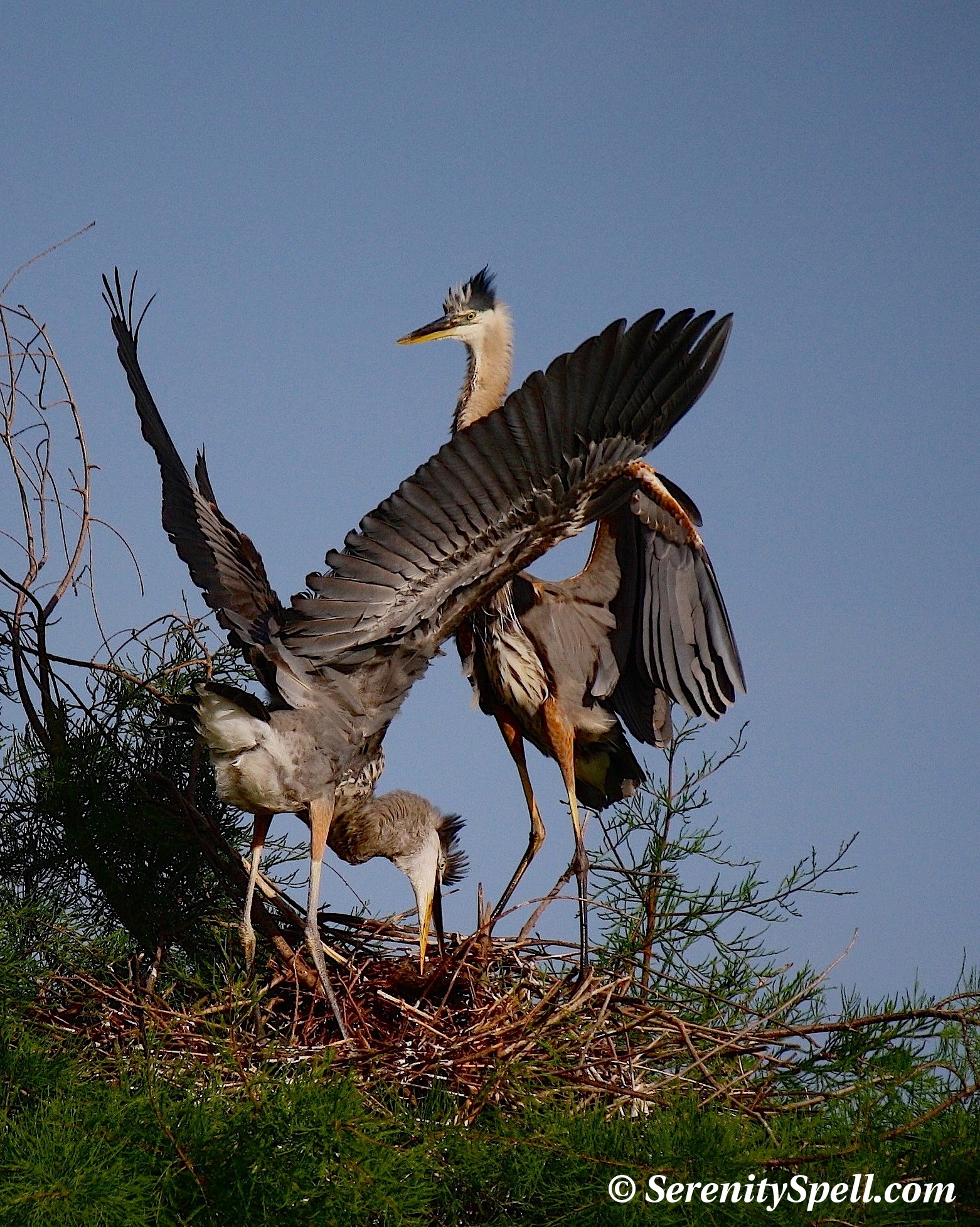
Great Blue Heron feeding her young on a tree-top nest

Big Like You: Momma Alligator with one of her babies

Anhinga Mealtime: Busy mother Anhinga with her brood

Red-winged Blackbird nest with a new momma

Red-winged Blackbird mother feeds her hatchlings

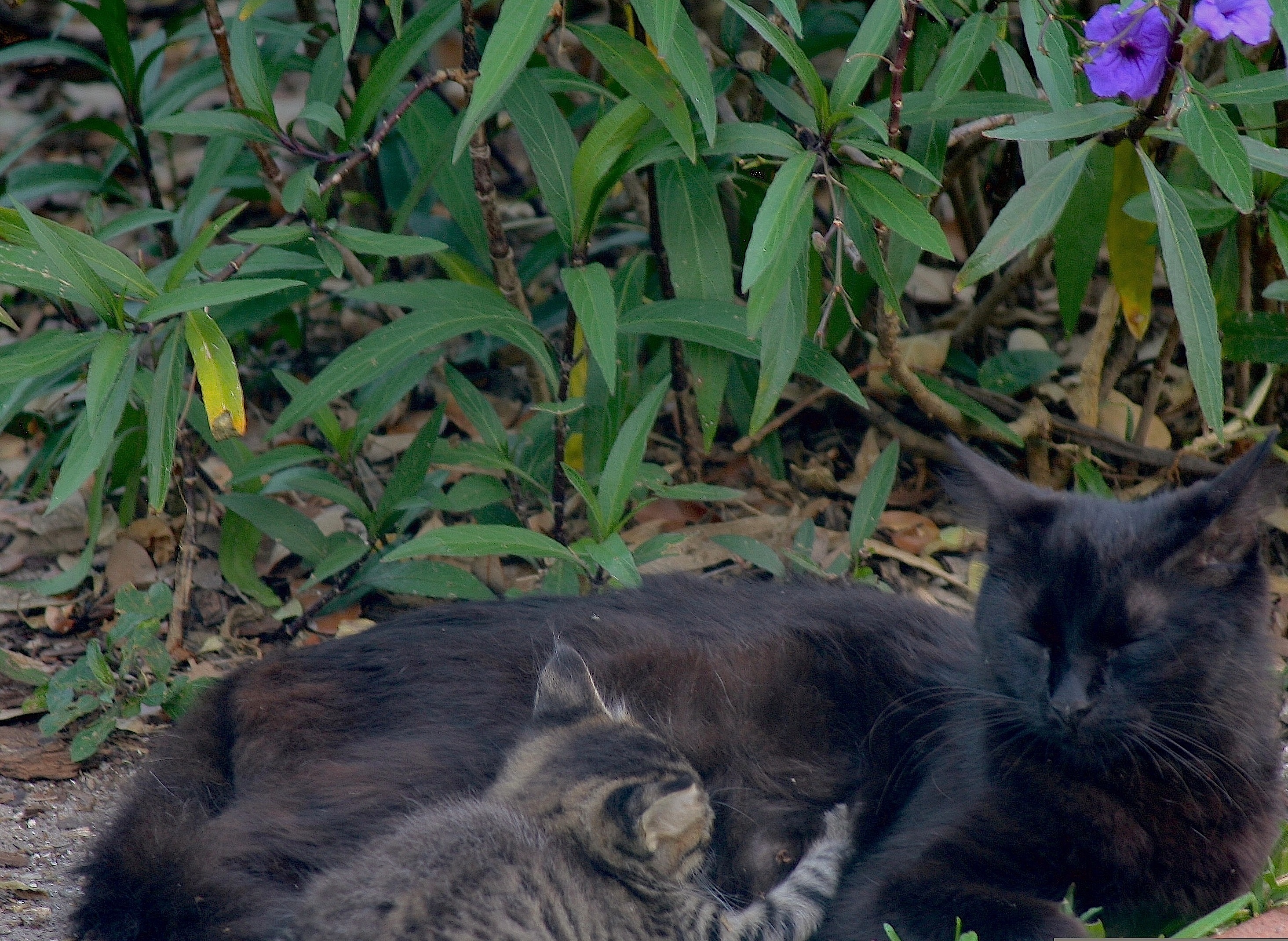
Our neighborhood stray cat and her kitten in our yard; such a good momma (now: TNR time!)

Pretty in Purple

Purple Gallinules are one of the shyer creatures of our wetlands, and to spy one is a fun and colorful event. Even if you’re a sly watcher and/or photographer, they’ll quickly flit into the dense marsh vegetation when they sense your presence…. It’s ironic, being as shy as they are, with such bold coloring. But it’s always a joy to spy these purple, blue, and green gems — especially so for me, as they’re all my favorite colors, wrapped up into one bright little bird.

These lovely creatures live in the freshwater marshes of the southeastern United States, as well as in Central America and the Caribbean — although they have turned up in the northern states and southern Canada, and even in parts of Europe and South Africa. There’s no mistaking this medium-sized rail, with its purple-blue plumage, green back, pale blue forehead, white undertail (of which I’ve caught more than one glimpse), bright red and yellow bill, and long yellow feet. The juveniles sport blander, brown colorations. The  gallinules’ huge legs make them awkward fliers, so short bursts of activity are their mode of transportation — or swimming like a duck if they’re not navigating the marsh with those dangling legs. They nest in floating constructs in the mashes (although I haven’t spotted many — they’re quite well hidden), laying 5-10 eggs.

The Purple Gallinule is omnivorous, eating the seeds, leaves, fruits, and grains of both aquatic and terrestrial plants; they also enjoy insects, frogs, snails, spiders, earthworms, fish, and even the eggs and young of other birds. When I see them in our wetlands, they’re often alone, nestled in the vegetation and cackling away — or being chased by other birds, most often by their sister species the Common Moorhen.

Purple Gallinule

Purple Gallinule — Nice Legs

Purple Gallinule

Purple Gallinule — White Undertail on Display

Purple Gallinule about to be chased into dense marsh vegetation by a defensive moorhen parent

Purple Gallinule successfully chased into dense marsh vegetation by a defensive moorhen parent

Time for Empty Nest Syndrome… Or Not?

I’ve written a post or two on the Red-winged Blackbirds — common songbirds found in most of North and much of Central America, and familiar sights in our protected wetlands and Everglades. The males, glossy black with scarlet-and-yellow shoulder patches, puff up or hide depending on their level of confidence. In our marshes, they’re quite brave (or protective, in defense-mode), doing their hardest to get noticed, and belting out their conk-la-ree songs. The female, subdued brown with streaks of lighter colorations, is much shyer than her male counterpart. Her brownish coloring serves to camouflage her and the nest, while she’s incubating. Staying low in the vegetation, she searches for food (eating primarily seeds and insects) and weaves her amazing nest. Constructed entirely over the course of 3-6 days — with no help from the males — the nests are woven in cattails, rushes, grasses, or in alder or willow bushes. Located near the water’s surface, the nest is a basket constructed of grasses, sedge, and mosses, lined with mud and bound to surrounding grasses or branches. I’ve watched for nearly an hour in awe, as a female patiently gathered her grasses from the surrounding wetlands — and even longer as another intricately wove her basket-nest. It’s beautifully mesmerizing (and believe me, I’m no birdwatching crackerjack). Red-winged Blackbirds nest in loose colonies, and the males serve as sentinels to guard the nests, using various calls to denote the type and severity of danger against such predators as snakes, raccoons, iguanas, and other birds.

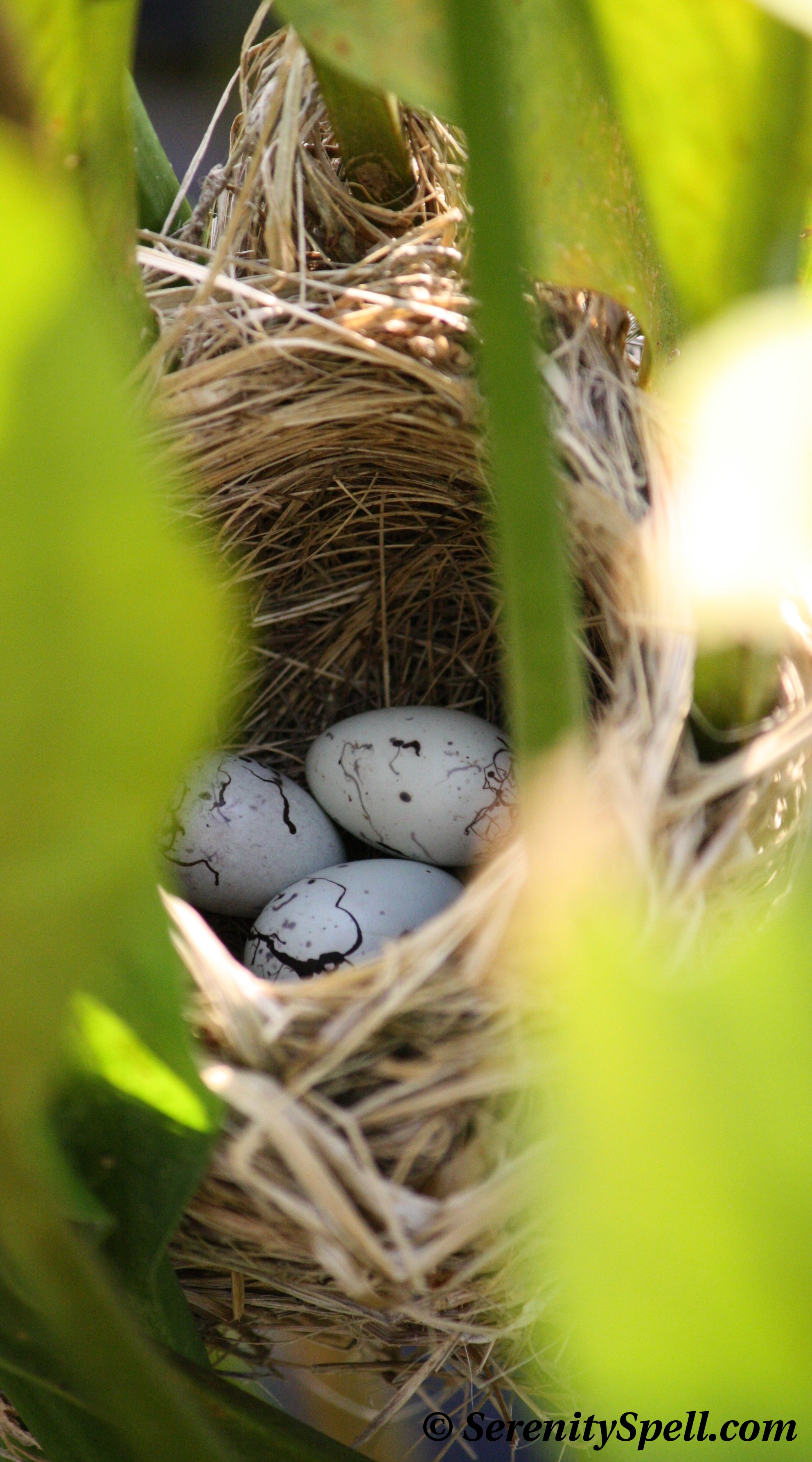
In my recent wanderings, I first became captivated by the spectacular artwork of the Blackbirds’ bluish eggs, marked with brown and/or black Pollock splatters. Incubated by the female alone, they hatched within 11-12 days. Being a large colony, there was no dearth of nests, but it wasn’t always easy to spy the eggs in the marsh vegetation:

Red-winged Blackbird Nest with Eggs

Then I fell in love with the hatchlings: born blind and naked, they were ready to leave the nest 11-14 days after hatching. Chirping away, they were ever-protected by their parents. But time flies quickly….

Red-winged Blackbird Nest with Hatchlings

Red-winged Blackbird Nest with Hatchlings

During recent walks, I began noticing more empty nests, over which I couldn’t help feeling irrationally sad…. Other than empty nests, I spied a momma Blackbird teaching her young ones early flight — or early adventures out of their nest. Was nesting season finished? Were there to be no more Red-winged Blackbird babies?

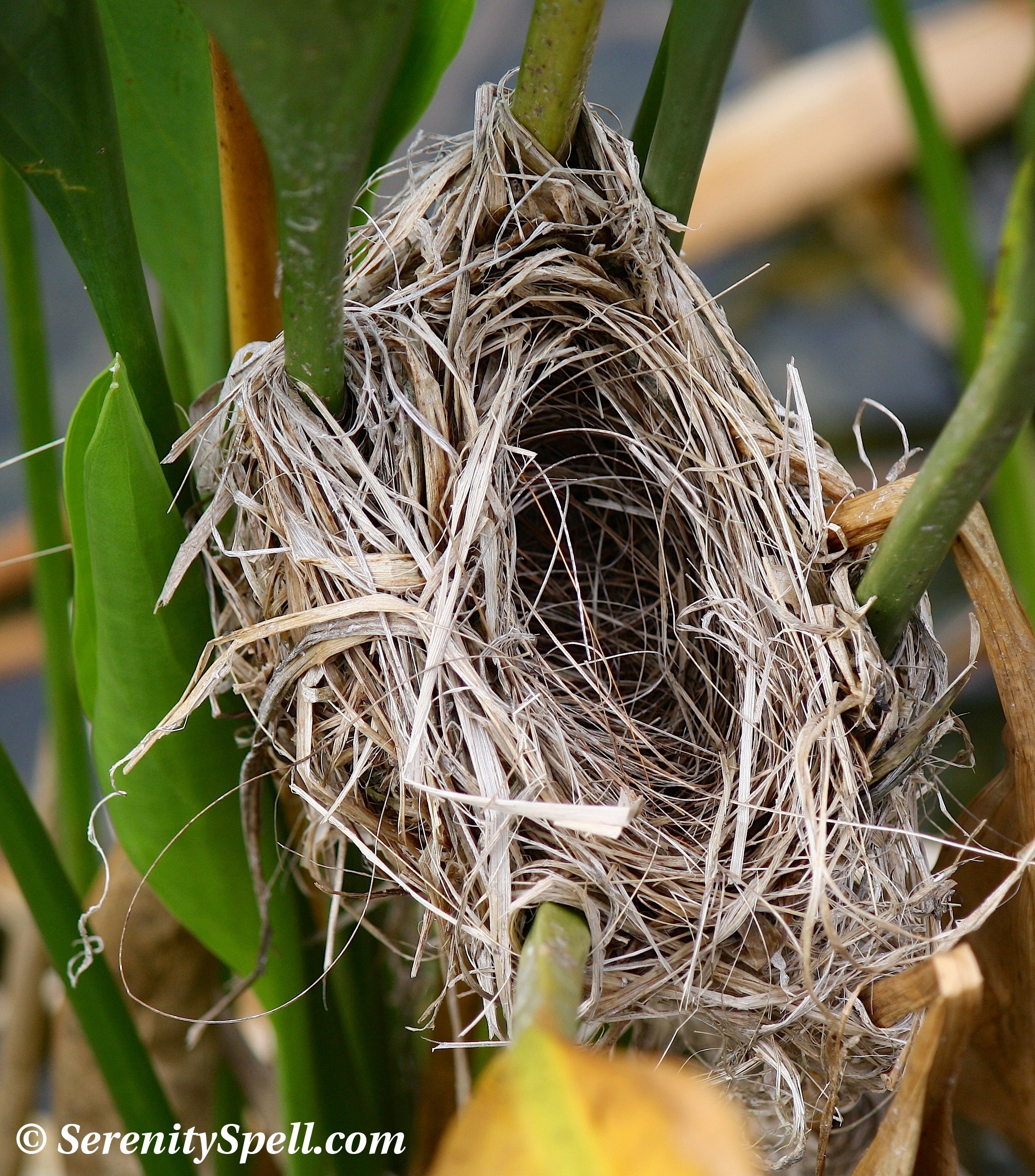
Empty Red-winged Blackbird Nest

Empty Red-winged Blackbird Nest

Empty Red-winged Blackbird Nest

Empty Red-winged Blackbird Nest

But over yonder! What was that commotion…. Lo and behold, a new nest! The male perched sentinel nearby, always the protector, while the female made her way to the nest, to incubate her new eggs. And the cycle continues, hoorah!

Female Red-winged Blackbird on Her Way to the Nest

Red-winged Blackbird Sentinel

A new nest, with eggs!!

Red-winged Blackbird Nest with a New Momma