Skip to content

Posts tagged ‘nature’

Growing Gator Baby — A Survivor!

I was lucky to have witnessed a mating pair of alligators during a recent trip to our protected wetlands — while I believe the actual mating had already occurred (as evidenced by the babies on the nearby bank), their  affinity for each other was obvious; Alligator Love: A Courtship offers opportune images of alligators’ elaborate courtship. Nearby were their offspring (8-9 counted) — as captured in Alligator Babies.

This little guy has grown quickly in the last 2-3 weeks; I didn’t spy any other siblings, but hopefully some have managed to survive the rigors of the swamp. After laying 20-50 eggs, the mother alligator closely guards her hatchlings — at 6-8 inches long, they’re near-replicas of the parents, save for a series of yellow and black stripes which camouflage beautifully with the surrounding marsh roots (the rings aren’t as pronounced in this more recent picture). They remain with her for five months before finding their own ways. We typically see 5-10 hatchlings survive in our protected wetlands — and even less make it to this age, as shown below. Common predators that prey upon the juvenile alligators include snapping turtles, snakes, raccoons, bobcats, raptors, and even larger male alligators.

Look at that face; I hope the little guy makes it….

Young Alligator in the Florida Wetlands

A Lady Grackle in a Pond-Apple Tree

Despite the commonality of these birds, I love to watch them. Well, I love to watch anything and everything when I’m out & about in nature, honestly — they’re all bright gems to me. I recently watched and photographed a Harvest Mouse for a good 15 minutes….

The Common Grackle (Quiscalus quiscula) is a large blackbird that’s often confused with the American Crow. Adult males are iridescent black, with long dark bills, long tails, and pale yellowish eyes. Females are slightly smaller and less glossy — brownish, in fact. Their song is a bit harsh, especially when it’s calm in our protected wetlands and several birds suddenly appear. They’re found across North America east of the Rocky Mountains, being permanent residents in much of this area. As forests were cleared for farmland, their range expanded west. Grackles nest in colonies, hiding their nests in dense trees and shrubs, often near water. These birds forage on the ground, in shallow water, or in shrubs — I’ve seen some interesting scenes of them skimming our wetlands’ duckweed in rapid flight for long periods of time…and I recently caught some photos of such an event. They’re omnivorous, and will steal food from other birds.

Pond-apple Tree Blossoms in the Florida Everglades
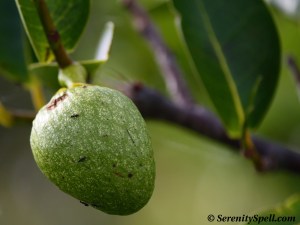
Young Pond Apple in the Florida Everglades

I caught this girl resting in a pond-apple tree, a common fixture in our wetlands, marshes, and the Everglades; they’re also known as Alligator-apple (for the fact that alligators will eat the fruit), Swamp-apple, Corkwood, Bobwood, and Monkey-apple. Unable to grow in dry soil and tolerant of saltwater, pond-apples are native to Florida, as well as the Caribbean, Central and South America, and West Africa. The tree averages 30-35 feet in height, and its blossoms are lovely creamy white and pale yellow, almost tulip-shaped. The fruit is apple-sized and mango-shaped, and falls when it’s green or ripening yellow. Edible to humans (it can be made into jam), the fruit serves as food for many species. It can be a bit bitter or tasteless for us, however (although its flesh is quite fragrant) — as my guy can attest to when I demanded he try it (“let’s make jam out of it!”). Pond-apple trees have become a scourge overseas, but in the Everglades they’re a valuable source of sustenance for our wildlife — I’ve seen alligator, raccoon, and all species of turtles munching on fallen pond apples. The trees provide shelter for myriad creatures, and their canopies are used as nesting grounds for all species of birds. Even more interesting, recent studies have shown that its alcoholic seed extract may provide anticancer compounds that could be used pharmaceutically.

Common Grackle in a Pond-apple Tree, Florida Wetlands

Common Grackle in a Pond-apple Tree, Florida Wetlands

Common Grackle in a Pond-apple Tree, Florida Wetlands

Pond-apple Tree: Note the thin trunks growing in clumps

Creating Our Backyard Wildlife Habitat: Step One, Provide Food

There have been many wonderful comments from people explaining how they’re creating natural habitats for their wildlife critters in their personal spaces (usually birds, but not always) — some of whose populations have suffered a decline in recent years. It’s crucial in our modern culture/society to do so; It doesn’t take much to provide a wee bit of food, water, and shelter for these guys…. Besides, it calms the soul to view nature. ♥

Here, Nature Mom teaches her son how to create a backyard wildlife habitat, something anyone can do, in any environment — I had a great little set-up in a former apartment. Following guidelines provided by the National Wildlife Federation (NWF), she details the creation and necessary resources for her local wildlife….

Linda Bernardi's avatarSuburban Nature Explorations

Today my son and I began working towards making our backyard into a Certified Wildlife Habitat, per the guidelines provided by the National Wildlife Federation (NWF). I figured it would be best for my four-year-old if we only focus on one aspect of certification at at a time. Our focus today? Step one: Provide Food for Wildlife.

Certification requires that the backyard provide three food sources, selected from the following list:

  • Seeds
  • Nuts
  • Berries
  • Fruits
  • Nectar
  • Sap
  • Foliage / Twigs
  • Pollen
  • Supplemental Feeders
    • Seed
    • Suet
    • Hummingbird
    • Squirrel
    • Butterfly

This was a fun, educational activity to work through with my son. What in our yard is food for wildlife? What could we add that wildlife could eat? What animals might eat each of the items on this list?

We decided our yard provides nuts (acorns from the oak tree), nectar (the rosemary flowers), and seed (supplemental bird feeders). We…

View original post 126 more words

Creating Our Backyard Wildlife Habitat: Step Two, Supply Water

Step 2 in the guidelines set forth by the National Wildlife Federation (NWF), in the creation of a backyard wildlife habitat: Supply Water!

Linda Bernardi's avatarSuburban Nature Explorations

For those of you who are following us, you know that yesterday my son and I started to create a wildlife habitat in our backyard, following the guidelines set by the National Wildlife Federation (NWF). Yesterday our focus was on providing food sources for wildlife. Today, we worked on step two… supply water for wildlife.

Certification requires that the backyard provide one water source, selected from the following list:

  • Lakefront
  • Seasonal Pond
  • Coastal
  • Birdbath
  • Water Garden / Pond
  • Rain Garden
  • Lake
  • River / Stream
  • Spring
  • Shallow Dish
  • Puddling Area

In the past, providing water in our yard for wildlife wasn’t something I thought about. Actually, my focus was on emptying out any little bit of pooled water I could find, as I don’t want any mosquitoes breeding in the yard. Also, there is a natural spring just on the other side of our fence, which is primarily what attracts…

View original post 184 more words

Creating our Backyard Wildlife Habitat: Step Three, Create Cover

Step 3 in the National Wildlife Federation (NWF)’s guidelines in the creation of a backyard wildlife habitat: Create Cover!

Linda Bernardi's avatarSuburban Nature Explorations

Today was day three of working towards making our backyard into a Certified Wildlife Habitat, per the guidelines provided by the National Wildlife Federation (NWF). So far, we’ve completed step 1 (provide food) and step two (supply water).  Our focus today? Create cover for wildlife.

This step in the certification process requires that a backyard has two types of cover for wildlife, selected from the following list:

  • Brush Pile
  • Log Pile
  • Wooded Area
  • Dense Shrubs / Thicket
  • Meadow / Prairie
  • Evergreens
  • Ground Cover
  • Roosting Box
  • Water Garden / Pond
  • Bramble Patch
  • Burrow
  • Cave
  • Rock Pile / Wall

This one was a bit tough for us, though my son had fun trying to build cover with the many sticks he’s collected over the years (photo below). We definitely already have one major cover for wildlife… our deck. But “deck” isn’t one of the items on…

View original post 199 more words