Skip to content

Posts tagged ‘florida’

Pretty Sssssnake

Initially we thought it was a young Cottonmouth…. Being near the water, and with the surrounding wetlands and fields. We’ve seen a few of them and their skins on our hikes through the Florida flatwoods and swamps — which is why I always wear my boots when we’re out and about! It’s their land, after all. I’m thankful to visit, each and every time.

But we realized it was far too bright, even for an infant Cottonmouth — besides, this was an adult (this realization reached after the human male jumped excitedly over the embankment to get a closer look). I researched it later, as I had honestly never seen one, in all my years here. It’s a Corn snake — otherwise known as a Red Rat snake, apparently quite common. The term “Corn snake” — dating as far back as the mid- to late 17th century — arose when southern farmers stockpiled their harvested ears of corn, attracting rodents. The rodents in turn attracted these snakes.

Corn snakes are found throughout the Southeastern and Central US, and are known to be extremely docile — not biting easily, and not aggressive — making them “ideal” pet snakes (boo). Averaging 3.9 – 6 feet, they’re considered a moderate-sized snake, and prefer habitats such as overgrown fields, trees, palmetto flatwoods, and abandoned buildings and farmlands. They host a wide variety of color and pattern variations, as well. I’m still in disbelief that I haven’t seen one of these lovelies on any of our hikes — they’re pretty hard to miss.

Corn Snake, or Red Rat Snake

Corn Snake, or Red Rat Snake

Happy Mommy’s Day

 Happy Mother’s Day! MUCH love to all the dedicated, devoted, and hard-working women — and female critters — of the world.

Me + Mom (w/ brother in belly) in Central FL, 1972, PRE-Disney — while swamps were being filled

Momma Grackle feeds her young

I’ll save *exactly* what the momma’s feeding the juvenile (below) for an upcoming post…. It’s just. That. Yummy!

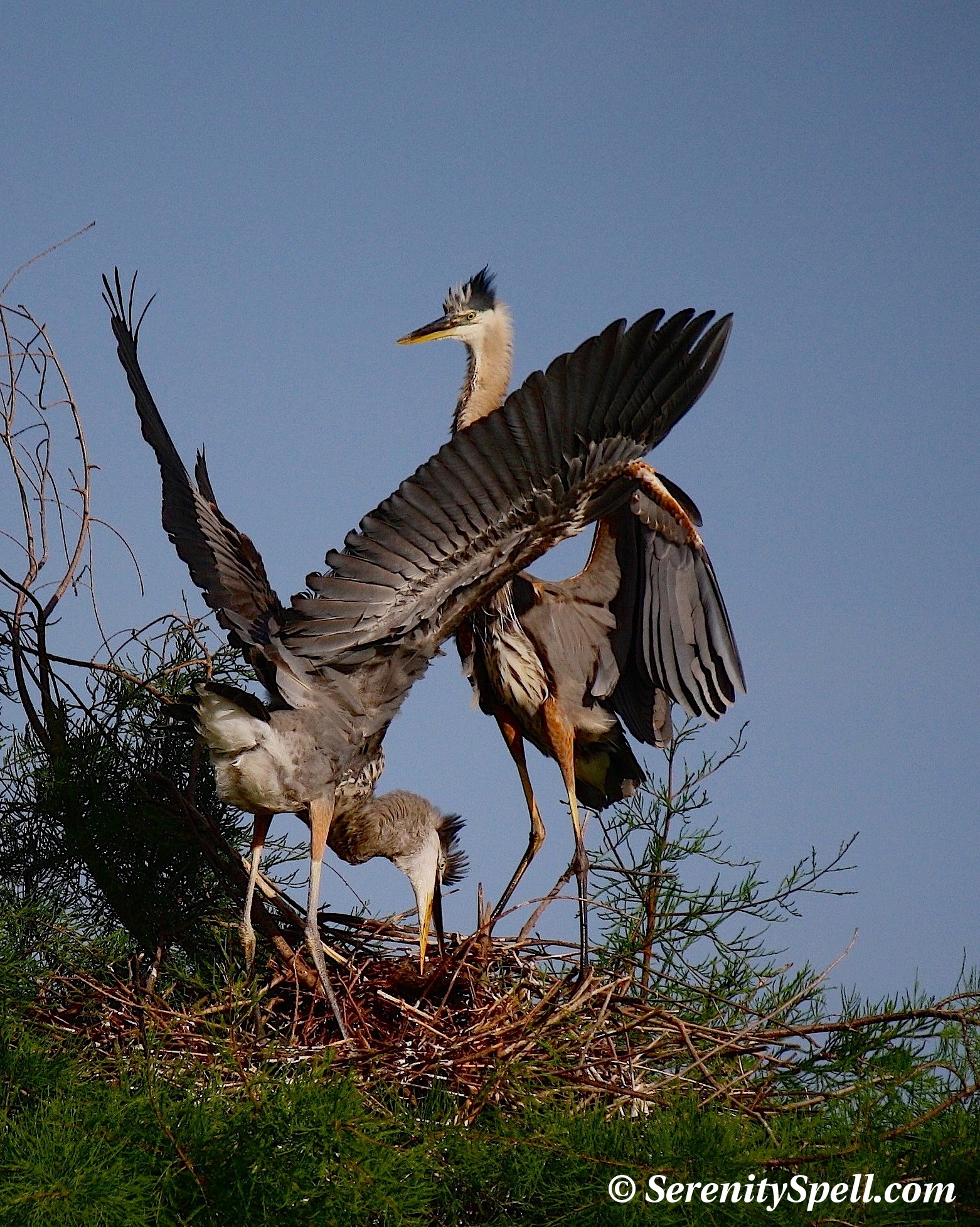
Great Blue Heron feeding her young on a tree-top nest

Big Like You: Momma Alligator with one of her babies

Anhinga Mealtime: Busy mother Anhinga with her brood

Red-winged Blackbird nest with a new momma

Red-winged Blackbird mother feeds her hatchlings

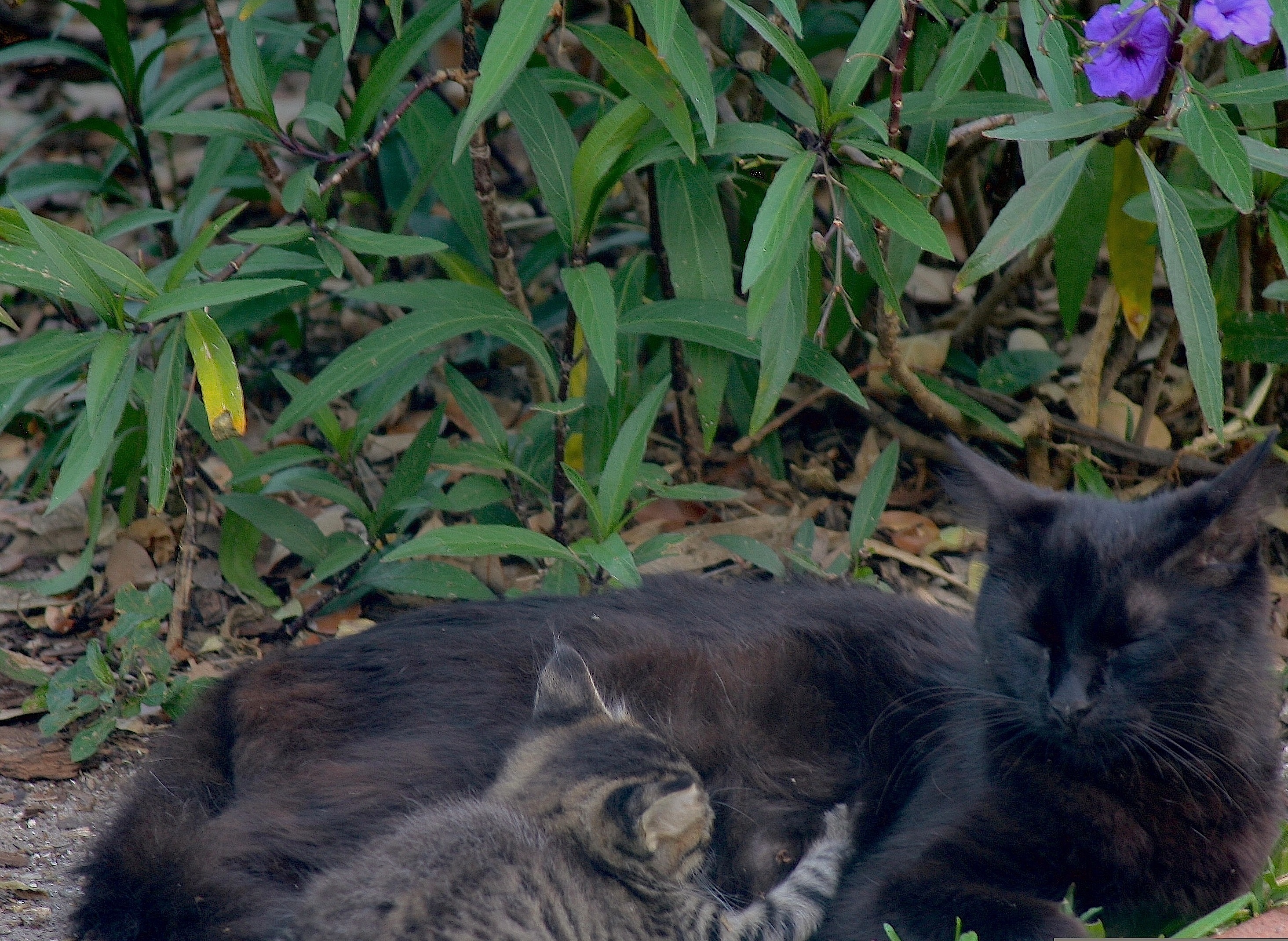
Our neighborhood stray cat and her kitten in our yard; such a good momma (now: TNR time!)

Pretty in Purple

Purple Gallinules are one of the shyer creatures of our wetlands, and to spy one is a fun and colorful event. Even if you’re a sly watcher and/or photographer, they’ll quickly flit into the dense marsh vegetation when they sense your presence…. It’s ironic, being as shy as they are, with such bold coloring. But it’s always a joy to spy these purple, blue, and green gems — especially so for me, as they’re all my favorite colors, wrapped up into one bright little bird.

These lovely creatures live in the freshwater marshes of the southeastern United States, as well as in Central America and the Caribbean — although they have turned up in the northern states and southern Canada, and even in parts of Europe and South Africa. There’s no mistaking this medium-sized rail, with its purple-blue plumage, green back, pale blue forehead, white undertail (of which I’ve caught more than one glimpse), bright red and yellow bill, and long yellow feet. The juveniles sport blander, brown colorations. The  gallinules’ huge legs make them awkward fliers, so short bursts of activity are their mode of transportation — or swimming like a duck if they’re not navigating the marsh with those dangling legs. They nest in floating constructs in the mashes (although I haven’t spotted many — they’re quite well hidden), laying 5-10 eggs.

The Purple Gallinule is omnivorous, eating the seeds, leaves, fruits, and grains of both aquatic and terrestrial plants; they also enjoy insects, frogs, snails, spiders, earthworms, fish, and even the eggs and young of other birds. When I see them in our wetlands, they’re often alone, nestled in the vegetation and cackling away — or being chased by other birds, most often by their sister species the Common Moorhen.

Purple Gallinule

Purple Gallinule — Nice Legs

Purple Gallinule

Purple Gallinule — White Undertail on Display

Purple Gallinule about to be chased into dense marsh vegetation by a defensive moorhen parent

Purple Gallinule successfully chased into dense marsh vegetation by a defensive moorhen parent

Growing Gator Baby — A Survivor!

I was lucky to have witnessed a mating pair of alligators during a recent trip to our protected wetlands — while I believe the actual mating had already occurred (as evidenced by the babies on the nearby bank), their  affinity for each other was obvious; Alligator Love: A Courtship offers opportune images of alligators’ elaborate courtship. Nearby were their offspring (8-9 counted) — as captured in Alligator Babies.

This little guy has grown quickly in the last 2-3 weeks; I didn’t spy any other siblings, but hopefully some have managed to survive the rigors of the swamp. After laying 20-50 eggs, the mother alligator closely guards her hatchlings — at 6-8 inches long, they’re near-replicas of the parents, save for a series of yellow and black stripes which camouflage beautifully with the surrounding marsh roots (the rings aren’t as pronounced in this more recent picture). They remain with her for five months before finding their own ways. We typically see 5-10 hatchlings survive in our protected wetlands — and even less make it to this age, as shown below. Common predators that prey upon the juvenile alligators include snapping turtles, snakes, raccoons, bobcats, raptors, and even larger male alligators.

Look at that face; I hope the little guy makes it….

Young Alligator in the Florida Wetlands

The Greening of the Great Egret

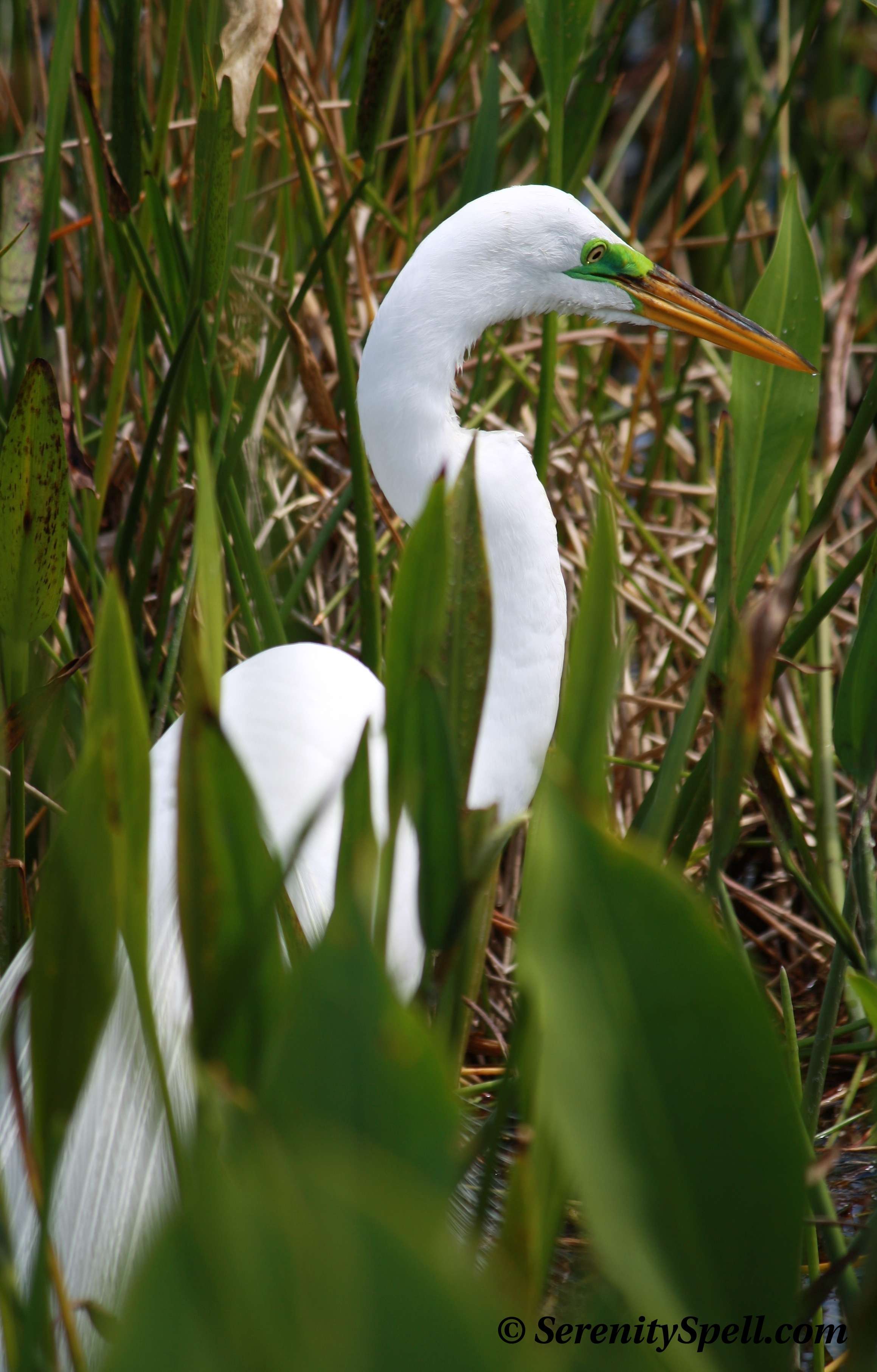
As mentioned in my previous post, I had to save an image of one Great Egret for its own space. At the beginning of this year’s breeding season I was able to catch a lovely model, sporting a shocking green lore — the area between the bill and the eyes. During the breeding season, the lore may turn a vibrant green; the Great Egret will also display long, elegant plumes on its back (evident in the second picture, slightly blocked by the swamp vegetation), which are used in courtship displays. Like a peacock, the feathery plumes will spread out like a fan. Outside the breeding season, these long feathers disappear.

Great Egrets are striking to spy in the swamp — their ethereal beauty, graceful stalking, and quiet strength is captivating. But the brilliant green lore and feathery plumes add yet more stunning display to an already magical scene.

Great Egret with Green Lore in the Florida Wetlands (Close-Up)

Great Egret with Green Lore in the Florida Wetlands